You’re scrolling through vacation photos and typing a caption, and “beautiful” is the only word that comes to mind, again. Or you’re writing a card for a friend’s wedding and you’ve already used “beautiful” twice in three sentences.
This happens constantly because “beautiful” is one of the most useful and overused words in English. It fits sunsets, faces, music, and ideas alike, which is exactly why it gets repeated so often.
Learning a few accurate alternatives helps your writing and speech feel more specific and a lot less repetitive.
QUICK ANSWER
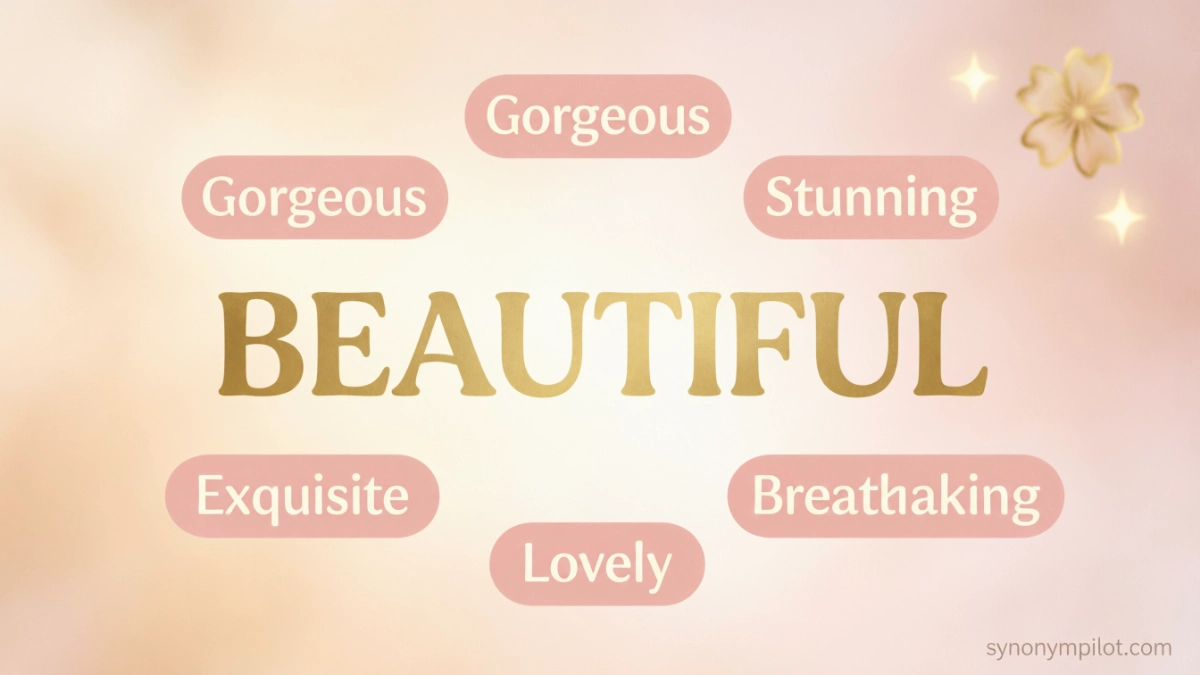
“Beautiful” describes something that’s pleasing to look at, hear, or experience, often in a way that feels emotionally moving or admirable. It can describe people, places, art, sounds, or even ideas and moments. Common synonyms include gorgeous, stunning, lovely, exquisite, and breathtaking.
MEANING, TONE & CONTEXT
At its core, “beautiful” means something is aesthetically pleasing or emotionally moving because of its appearance, sound, or quality. It’s a warm, positive word that works across nearly every context.
The tone of “beautiful” is flexible. It sounds natural in casual conversation (“that dress is beautiful”), in formal writing (“a beautifully composed symphony”), and in emotional or personal contexts (“she has a beautiful soul”). It rarely feels out of place.
“Beautiful” sounds most natural when describing physical appearance, nature, art, or meaningful experiences. It’s less common, though still acceptable, when describing abstract things like ideas or relationships, where words like “wonderful” or “lovely” sometimes fit slightly better.
WHEN & HOW TO USE “BEAUTIFUL”
Use “beautiful” when you want to express genuine admiration for how something looks, sounds, or feels.
In casual conversation, it works for almost anything visually or emotionally pleasing: “That sunset over the lake was absolutely beautiful.”
In writing, it adds warmth and admiration to descriptions: “The bride wore a beautiful gown that caught the light with every step.”
In professional or creative contexts, it can describe craftsmanship or design: “The architect’s beautiful use of natural light transformed the entire building.”
ANOTHER WORD FOR BEAUTIFUL
If you need one reliable, everyday alternative, “gorgeous” is the closest match. It carries a similarly strong, positive tone but feels slightly more emphatic and casual, making it a natural fit for conversation, social media captions, and informal writing.
WHEN NOT TO USE THIS WORD
Avoid “beautiful” in technical or analytical writing where objective description matters more than aesthetic judgment. Describing a chemical structure as “beautiful” in a lab report, for instance, sounds out of place and overly subjective.
It’s also worth avoiding in contexts where it could sound insincere or overly generic, like repeatedly calling every dish at a restaurant “beautiful” in a review. More specific words such as “vibrant,” “elegant,” or “well presented” communicate more useful detail.
WORDS COMMONLY CONFUSED WITH BEAUTIFUL
People often confuse “beautiful” with “pretty.” Pretty usually describes something attractive in a lighter, simpler way, while beautiful suggests a deeper or more striking level of attractiveness, often with emotional impact.
“Beautiful” also gets mixed up with “handsome.” Handsome traditionally describes attractive men or sometimes striking, well proportioned objects, while beautiful applies more broadly across genders and contexts.
Finally, “beautiful” is sometimes confused with “cute.” Cute usually implies a charming, often smaller scale appeal, like a puppy or a child’s drawing, while beautiful suggests a stronger, more striking aesthetic quality.
Best Synonym by Context for Beautiful
| Context | Best Synonym | Why It Fits |
|---|---|---|
| Describing people | Gorgeous, Stunning | Conveys strong physical attractiveness |
| Describing nature/scenery | Breathtaking, Picturesque | Captures scale and visual impact |
| Describing art/design | Exquisite, Elegant | Suggests refined craftsmanship |
| Describing moments/experiences | Magical, Touching | Conveys emotional resonance |
| Everyday casual speech | Gorgeous, Lovely | Sounds natural and conversational |
| Formal or literary writing | Exquisite, Resplendent | Sounds polished and descriptive |
| Marketing and advertising | Stunning, Unforgettable | Creates strong appeal and attention |
| Fashion and beauty | Elegant, Radiant | Highlights style and attractiveness |
| Travel writing | Majestic, Scenic | Emphasizes impressive landscapes |
| Academic or professional writing | Aesthetic, Attractive | More objective and precise |
| Creative storytelling | Enchanting, Captivating | Creates vivid imagery and emotion |
| Architecture and interiors | Magnificent, Polished | Highlights design quality and grandeur |
| Romantic descriptions | Lovely, Ravishing | Expresses admiration and affection |
| Photography and media | Photogenic, Striking | Focuses on visual impact |
| Luxury branding | Exquisite, Sublime | Suggests exclusivity and high quality |
WHICH SYNONYM SHOULD YOU CHOOSE?
Start by identifying what kind of beauty you’re describing. For people, “gorgeous” or “stunning” work well, while “breathtaking” or “picturesque” suit landscapes and scenery more naturally. For art, design, or craftsmanship, “exquisite” or “elegant” capture refinement better than general terms.
Next, think about emotional intensity. If something is mildly attractive, “lovely” or “pretty” fit better than stronger words like “breathtaking” or “stunning,” which imply a more powerful reaction. Matching intensity to the actual experience keeps your language honest and effective.
REAL LIFE EXAMPLES OF “BEAUTIFUL” IN SENTENCES
School: “The art teacher said the mural was one of the most beautiful student projects she’d seen all year.”
Workplace: “The client loved the beautiful design concepts we presented during the pitch.”
Writing: “The garden looked beautiful in early spring, with tulips lining every path.”
Conversation: “Your new apartment is beautiful, I love how bright it feels.”
50 Synonyms for Beautiful
| Synonym | Simple Meaning | Example Sentence |
|---|---|---|
| Gorgeous | Extremely attractive or pleasing | She wore a gorgeous dress to the gala. |
| Stunning | Strikingly attractive, often surprisingly so | The view from the cliff was absolutely stunning. |
| Lovely | Pleasant and attractive in a gentle way | They spent a lovely afternoon walking along the beach. |
| Exquisite | Extremely beautiful, often due to fine detail | The necklace featured exquisite handcrafted detailing. |
| Breathtaking | So beautiful it takes your breath away | The mountain view was breathtaking at sunrise. |
| Striking | Noticeably attractive or impressive | Her striking red hair stood out in every photo. |
| Radiant | Glowing with beauty or happiness | The bride looked radiant walking down the aisle. |
| Picturesque | Visually charming, like a picture | The picturesque village attracted tourists year round. |
| Magnificent | Impressively beautiful or grand | The magnificent palace drew visitors from around the world. |
| Elegant | Gracefully and tastefully beautiful | The elegant ballroom was decorated with soft lighting. |
| Charming | Pleasantly attractive, often through personality or detail | The charming cottage had flowers growing along the fence. |
| Attractive | Pleasing in appearance | The attractive layout made the website easy to enjoy. |
| Pretty | Pleasant to look at, often in a simple way | She wore a pretty floral dress to the picnic. |
| Handsome | Attractive, especially in a strong or dignified way | He looked handsome in his new suit. |
| Dazzling | Impressively bright or beautiful | The dazzling fireworks lit up the entire sky. |
| Resplendent | Brilliantly beautiful, especially in appearance | The cathedral looked resplendent under the evening lights. |
| Splendid | Magnificently beautiful or impressive | They admired the splendid views from the rooftop terrace. |
| Glorious | Beautiful in a grand, impressive way | The glorious sunset painted the sky in orange and pink. |
| Sublime | Beautiful in an elevated, almost spiritual way | The choir’s harmony felt sublime in the quiet cathedral. |
| Captivating | Beautiful in a way that holds attention | Her captivating smile lit up the entire room. |
| Enchanting | Beautiful in a magical, charming way | The enchanting garden felt like something from a fairy tale. |
| Graceful | Beautiful through smooth, elegant movement or form | The dancer moved with graceful precision across the stage. |
| Alluring | Attractive in a tempting or magnetic way | The alluring scent of fresh bread filled the bakery. |
| Delightful | Pleasing and enjoyable to experience | The delightful garden party lasted well into the evening. |
| Heavenly | Extremely beautiful or pleasing | The heavenly view from the balcony took her breath away. |
| Divine | Wonderfully or perfectly beautiful | The dessert tasted absolutely divine. |
| Adorable | Charmingly attractive, often in a small or sweet way | The puppy looked adorable curled up on the rug. |
| Cute | Pleasingly attractive, often in a light or playful way | Her cute haircut suited her new style. |
| Photogenic | Looking attractive in photographs | The coastal town was extremely photogenic at golden hour. |
| Comely | Pleasant looking, often used for people | The novel described a comely young woman from the village. |
| Fair | Beautiful, especially in literary writing | The fair maiden appeared in countless folk tales. |
| Pulchritudinous | Physically beautiful (formal, rare) | Critics described the painting’s subject as pulchritudinous. |
| Aesthetic | Pleasing in visual or artistic quality | The café had a clean, aesthetic interior design. |
| Statuesque | Tall, elegant, and beautiful in form | The statuesque model walked confidently down the runway. |
| Ravishing | Extremely and strikingly beautiful | She looked ravishing in the deep red gown. |
| Bewitching | Beautiful in a captivating, magical way | His bewitching voice held the audience completely silent. |
| Idyllic | Beautifully peaceful, especially in nature | They spent an idyllic weekend at the lake house. |
| Scenic | Beautiful in landscape or natural view | The scenic drive along the coast took nearly three hours. |
| Majestic | Grand and impressively beautiful | The majestic waterfall roared down the cliffside. |
| Flawless | Perfectly beautiful, without imperfection | Her flawless complexion glowed in the soft lighting. |
| Polished | Refined and attractively finished | The polished presentation impressed every client in the room. |
| Vibrant | Bright, lively, and beautiful | The vibrant mural brought color to the entire street. |
| Luminous | Beautifully glowing or radiant | Her luminous skin seemed to glow under the studio lights. |
| Pristine | Beautifully clean, fresh, and untouched | The pristine beach looked untouched by tourists. |
| Eye catching | Visually beautiful or noticeable | The eye catching display drew customers into the shop. |
| Hot | Very physically attractive (informal) | Everyone agreed the new actor was incredibly hot. |
| Fine | Attractive, used casually (informal) | He’s looking fine in that new jacket. |
| Smoking | Extremely attractive (slang) | She looked smoking in that outfit at the party. |
| A knockout | Someone strikingly attractive (slang) | Everyone agreed she was a total knockout at prom. |
| Drop dead gorgeous | Extremely beautiful (informal) | He called her drop dead gorgeous the moment she walked in. |
| Easy on the eyes | Pleasant or attractive to look at | The new office design is really easy on the eyes. |
SYNONYM GROUPS & USAGE DIFFERENCES
Formal
Words like “exquisite,” “resplendent,” and “sublime” suit literary writing, formal descriptions, and elevated speech. They sound polished and intentional rather than casual.
Informal
“Gorgeous,” “lovely,” and “cute” fit everyday conversation and casual writing comfortably, sounding warm without feeling overly formal.
Slang
“Hot,” “fine,” “smoking,” “a knockout,” and “drop dead gorgeous” are casual, often used among friends or in informal social contexts. These work well in spoken English but should be avoided in professional or academic writing.
Professional
“Elegant,” “polished,” and “aesthetic” suit workplace or design related contexts, especially when describing presentations, products, or spaces.
Strongest vs. Weaker
“Breathtaking,” “stunning,” and “ravishing” sit at the strongest end, describing something with powerful visual or emotional impact. “Pretty” and “cute” sit at the weaker end, suitable for milder admiration.
Modern vs. Old Fashioned
“Gorgeous” and “stunning” feel current and widely used today. “Comely” and “fair” carry an old fashioned, literary tone, more common in classic novels or poetry than everyday modern speech.
Antonyms of Beautiful
| Antonym | Meaning | Example Sentence |
|---|---|---|
| Ugly | Unpleasant or unattractive in appearance | The old building looked ugly compared to its modern neighbors. |
| Plain | Simple and lacking distinctive beauty | The room had plain, unremarkable furniture. |
| Unattractive | Not pleasing in appearance | He found the design unattractive and outdated. |
| Hideous | Extremely unpleasant or ugly | The hideous wallpaper made the room feel dated. |
| Drab | Dull and lacking visual appeal | The office walls were painted a drab shade of gray. |
| Unsightly | Unpleasant to look at | The unsightly construction site blocked the view. |
| Repulsive | Causing strong dislike or disgust in appearance | The mold made the basement walls look repulsive. |
COMPARISON SECTION
Beautiful vs. Pretty
“Pretty” usually describes something attractive in a lighter, simpler way, while “beautiful” suggests deeper or more striking attractiveness, often with stronger emotional impact. Example: “A pretty flower” sounds gentle and simple, while “a beautiful sunset” carries more emotional weight.
Beautiful vs. Gorgeous
“Gorgeous” carries a slightly more intense and casual tone than “beautiful,” often used in spoken English for emphasis. Both describe strong attractiveness, but “gorgeous” feels more exclamatory, as in “You look gorgeous tonight!”
Beautiful vs. Handsome
“Handsome” traditionally describes attractive men or strong, well proportioned objects, while “beautiful” applies more broadly across people, places, and things. Calling a man “beautiful” is increasingly common today, though “handsome” remains the more traditional choice in many contexts.
Beautiful vs. Cute
“Cute” implies a charming, often smaller scale or playful appeal, like a kitten or a child’s smile, while “beautiful” suggests a stronger, more striking aesthetic quality. A baby’s smile is cute; a wedding gown is beautiful.
COMMON PHRASES & EXPRESSIONS
“Beauty is in the eye of the beholder”
Means that what one person finds beautiful, another might not. Example: “He thought the painting was strange, but beauty is in the eye of the beholder.”
“A sight for sore eyes”
Describes something or someone beautiful and welcome to see. Example: “After months away, seeing home again was a sight for sore eyes.”
“Easy on the eyes”
Means pleasant or attractive to look at, often used casually. Example: “The new café’s interior is really easy on the eyes.”
“Drop dead gorgeous”
Describes someone extremely beautiful, often used for emphasis. Example: “She walked in looking drop dead gorgeous in that emerald dress.”
“A picture perfect moment”
Describes a beautifully ideal scene or experience. Example: “The wedding ceremony on the beach was a picture perfect moment.”
COMMON MISTAKES TO AVOID
Don’t overuse “beautiful” for everything, since repeating it too often weakens its impact. Avoid confusing “beautiful” with “pretty,” as pretty describes a lighter, simpler kind of attractiveness rather than deep visual or emotional impact. Be careful using slang synonyms like “hot” or “fine” in professional or written contexts, since they sound too casual outside of conversation. Finally, remember that “handsome” and “beautiful” aren’t always interchangeable depending on tradition and context, so consider your audience before choosing one.
FAQs
What’s a stronger word than beautiful?
“Breathtaking,” “stunning,” and “ravishing” all express a more intense level of beauty, often implying a powerful emotional or visual reaction.
What’s a casual way to say beautiful?
“Gorgeous,” “lovely,” and slang terms like “fine” or “hot” work well in everyday, informal conversation.
What’s the difference between beautiful and gorgeous?
“Gorgeous” feels slightly more intense and casual, often used for emphasis in speech, while “beautiful” works comfortably in both casual and formal contexts.
Can “beautiful” describe things other than appearance?
Yes. “Beautiful” can describe music, moments, relationships, or even ideas, as in “a beautiful friendship” or “a beautiful melody,” extending beyond just visual appearance.
Is it okay to call a man beautiful?
Yes, though “handsome” remains the more traditional word for men. “Beautiful” is increasingly used for all genders today, especially in casual or modern speech.
CONCLUSION
Building a richer vocabulary around words like “beautiful” helps your descriptions feel more specific and genuine, instead of repeating the same word for every pleasing sight or experience. Each alternative carries its own shade of meaning, from the quiet charm of “lovely” to the powerful impact of “breathtaking.”
Paying attention to context, formality, and emotional intensity helps you choose the word that actually matches what you’re describing.
Try using a few new synonyms the next time you want to express admiration, and notice how much more vivid and natural your language becomes. Small vocabulary changes like these make everyday communication feel more thoughtful and alive.

Hi, I’m Camron White, a word lover who enjoys exploring the beauty of the English language. I write about synonyms, meanings, and everyday vocabulary to help readers express themselves more clearly and confidently. My goal is to make learning new words simple, fun, and useful in real-life conversations. synonympilot.com