Imagine you’re writing a project proposal and you type: “This strategy aligns with our company goals.” It sounds fine but what if you’ve already used “aligns” three times in the same paragraph? Or what if you’re writing an academic paper and the word feels too casual? That’s exactly when knowing strong synonyms for “aligns” becomes a real writing advantage.
If you’re a student, a professional, or someone learning English, expanding your vocabulary around common words like “aligns” helps you write with more variety, precision, and confidence.
What Does “Aligns” Mean? (Featured Snippet Definition)
“Aligns” is a verb that means to bring things into agreement, proper order, or a shared direction. It describes the act of making two or more things match, coordinate, or move toward the same goal. You can use it to talk about physical positioning, ideas, values, strategies, or relationships.
Meaning, Tone, and Context
At its core, “aligns” carries the idea of agreement and coordination. When something aligns with something else, they fit together they point in the same direction or share the same purpose.
In terms of tone, “aligns” sits comfortably in the middle ground. It’s not too formal, not too casual. You’ll hear it in business meetings, academic writing, political speeches, and everyday conversation.
It works especially well in professional and corporate settings “Our values align with the client’s vision” but also appears naturally in personal contexts: “My schedule aligns with yours, so let’s meet.”
The word carries a neutral to slightly formal tone, which makes it flexible. It doesn’t carry strong emotion on its own, though the context around it can make it feel positive (alignment as harmony) or strategic (alignment as deliberate coordination).
When and How to Use “Aligns”
“Aligns” shows up most naturally when you’re talking about:
- Goals or strategies matching a broader mission (“The plan aligns with our long term objectives”)
- Two people or groups agreeing on something (“Their views align on most issues”)
- Physical positioning (“Make sure the arrow aligns with the center mark”)
- Values and beliefs fitting together (“Her personal values align with the organization’s principles”)
- Timing working out well (“The launch date aligns perfectly with the product rollout”)
One important note: “aligns” is usually followed by “with.” You align with something. Saying “this aligns our strategy” without a preposition can sound incomplete unless used transitively (as in “this aligns our team”).
50 Synonyms for “Aligns”
| Synonym | Simple Meaning | Example Sentence |
|---|---|---|
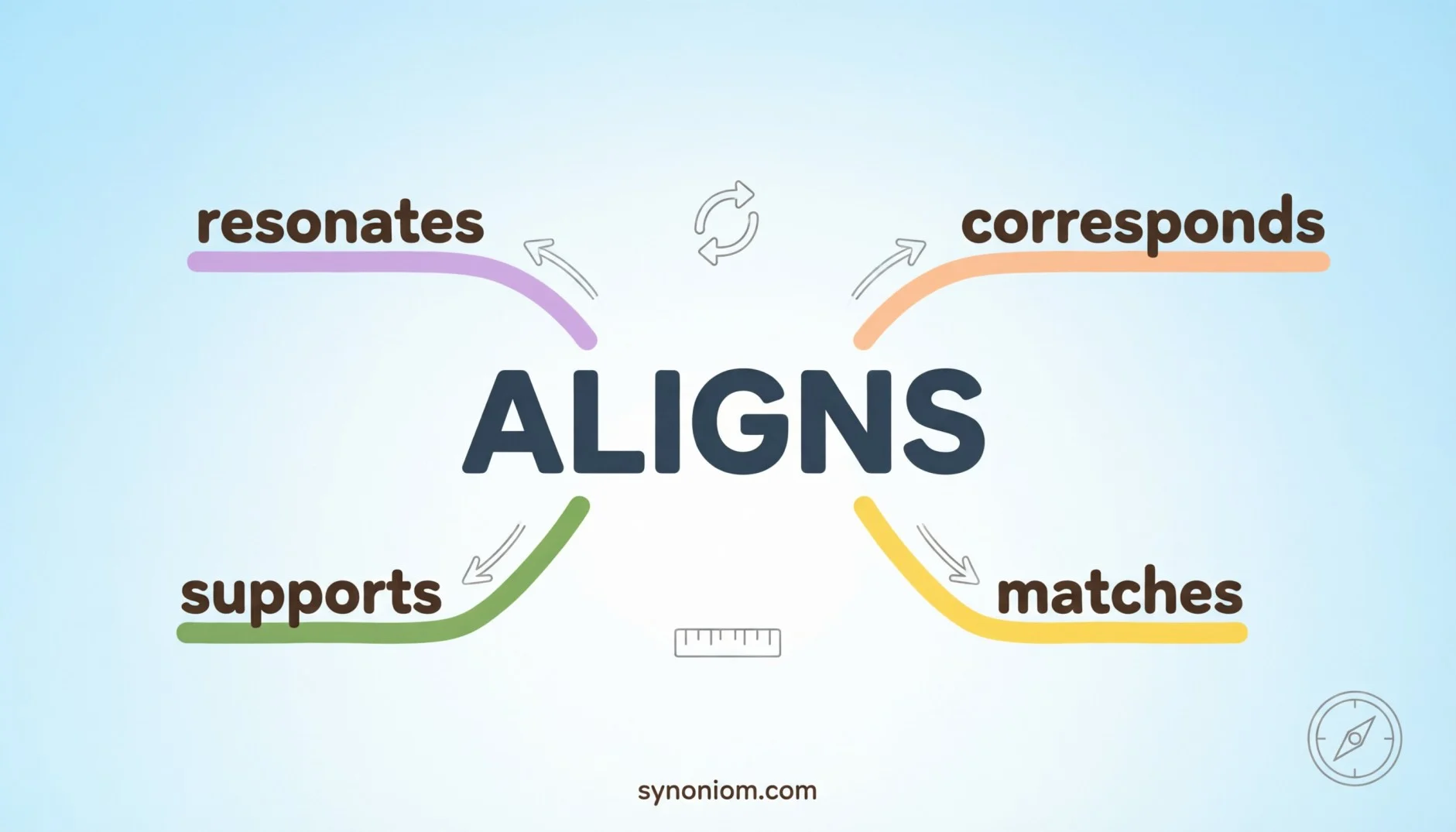
| Matches | is equal or similar | Her skill set matches the job requirements. |
| Corresponds | has a clear connection | The data corresponds to our predictions. |
| Agrees with | is in harmony | His opinion agrees with the committee’s decision. |
| Fits | is suitable | This solution fits our budget perfectly. |
| Coordinates | works together well | The departments coordinate effectively. |
| Harmonizes | creates balance | The policy harmonizes with regulations. |
| Synchronizes | matches timing | The team synchronizes its workflow. |
| Conforms to | follows standards | The product conforms to safety standards. |
| Supports | backs up | This evidence supports the theory. |
| Reinforces | strengthens | Her findings reinforce the hypothesis. |
| Complements | enhances | His style complements the team approach. |
| Parallels | mirrors closely | This trend parallels last quarter’s results. |
| Resonates with | connects meaningfully | The message resonates with young audiences. |
| Coheres with | fits logically | The chapter coheres with the theme. |
| Integrates with | combines smoothly | The software integrates with major platforms. |
| Ties in with | connects naturally | The research ties in with earlier findings. |
| Is consistent with | does not contradict | The results are consistent with projections. |
| Suits | is appropriate | This strategy suits the company’s growth. |
| Squares with | matches logically | His explanation squares with observations. |
| Concurs with | formally agrees | The panel concurs with the recommendation. |
| Adheres to | sticks to | The plan adheres to ethical guidelines. |
| Coincides with | happens similarly | The event coincides with our launch. |
| Falls in line with | follows or matches | The guidelines fall in line with best practices. |
| Goes along with | agrees with | The decision goes along with expectations. |
| Connects with | links meaningfully | The campaign connects with audiences emotionally. |
| Blends with | merges smoothly | Her style blends with the team culture. |
| Dovetails with | fits together neatly | The proposal dovetails with the plan. |
| Is in step with | moves together | The brand stays in step with trends. |
| Is in tune with | responsive to | The manager is in tune with team needs. |
| Accommodates | adjusts to fit | The policy accommodates diverse styles. |
| Matches up with | corresponds well | His skills match up with the role. |
| Converges with | comes together | Their ideas converge on one principle. |
| Balances with | stays proportional | The risk balances with the reward. |
| Is attuned to | sensitive to | The service is attuned to feedback. |
| Is compatible with | works well together | The format is compatible with older devices. |
| Reflects | shows or expresses | The decision reflects company values. |
| Echoes | mirrors or repeats | His conclusion echoes the report. |
| Upholds | supports and maintains | The ruling upholds fair treatment. |
| Tracks with | follows closely | The forecast tracks with market behavior. |
| Links to | connects with | The initiative links to sustainability goals. |
| Is on the same page as | informally agrees | The team is on the same page as the client. |
| Jives with | informally fits | The plan jives with management goals. |
| Clicks with | fits naturally | The message clicked with the audience. |
| Lines up with | agrees or matches | The timeline lines up with production. |
| Gels with | works well together | His personality gels with the team. |
| Meshes with | fits smoothly | The system meshes with old infrastructure. |
| Pairs well with | combines effectively | This idea pairs well with marketing. |
| Is on board with | agrees and supports | Everyone is on board with the roadmap. |
| Syncs with | matches or coordinates | The calendar syncs with devices. |
| Is in accord with | formally agrees | The proposal is in accord with terms. |
Important Synonym Groups
Formal Synonyms
Use these in reports, academic writing, legal documents, or official communication:
- Corresponds, Conforms to, Adheres to, Is consistent with, Is in accord with, Concurs with, Coheres with
These words signal precision and professionalism. “The findings correspond to the established data” sounds polished and authoritative.
Informal / Conversational Synonyms
Use these in everyday speech, casual emails, or friendly writing:
- Jives with, Gels with, Clicks with, Is on the same page as, Goes along with, Lines up with
These feel natural and relaxed. “I think this idea really gels with what we talked about” works well in a team chat or casual meeting.
Academic Synonyms
These are preferred in research papers, essays, and scholarly articles:
- Parallels, Corresponds, Converges with, Reflects, Reinforces, Upholds, Is consistent with
Professional / Business Synonyms
Common in corporate environments, presentations, and strategy documents:
- Integrates with, Synchronizes, Coordinates, Supports, Complements, Dovetails with, Accommodates
Emotional / Relational Synonyms
These add a human, feeling based tone when writing about people or relationships:
- Resonates with, Is in tune with, Is attuned to, Connects with, Harmonizes
“This speech resonates with people who’ve gone through hardship” feels more personal and moving than simply “aligns with.”
Slang / Very Casual Synonyms
These appear in social media, casual texting, or informal spoken English:
- Jives with, Clicks with, Syncs with, Gels with
Antonyms of “Aligns”
| Antonym | Meaning | Example Sentence |
|---|---|---|
| Contradicts | directly opposes | His statement contradicts the data. |
| Clashes with | creates conflict | The policy clashes with procedures. |
| Conflicts with | is in disagreement | His schedule conflicts with the meeting. |
| Diverges from | moves away from | The results diverge from expectations. |
| Opposes | works against | The proposal opposes the committee’s goals. |
| Deviates from | moves away from standard | The product deviates from the approved design. |
| Misaligns with | improperly matched | The campaign misaligns with brand values. |
| Undermines | weakens or goes against | This move undermines team collaboration. |
| Is at odds with | is in disagreement | Her priorities are at odds with the organization’s direction. |
Comparison: “Aligns” vs. Similar Words
Aligns vs. Matches “Aligns” suggests a deliberate coming together of direction or purpose it’s about coordination. “Matches” is more about similarity or equality. You’d say “our goals align” when you want to stress that two things are working toward the same end. You’d say “the colors match” when focusing on similarity.
Aligns vs. Corresponds
“Corresponds” has a stronger academic and formal tone. It often implies a one to one relationship. “Aligns” is broader and more dynamic. In business writing, “aligns” feels more active; in research, “corresponds” feels more precise.
Aligns vs. Resonates
“Resonates” is more emotional. It refers to a deep personal or emotional connection not just logical agreement. “This message resonates with me” carries feeling. “This message aligns with our strategy” is more logical and structural.
Aligns vs. Integrates
“Integrates” suggests combining parts into a whole. “Aligns” suggests coordination without necessarily merging. Two strategies can align without being integrated into one.
Aligns vs. Conforms
“Conforms” suggests following a rule or standard, often with an external expectation. “Aligns” is more neutral and suggests mutual agreement. “Conforms” can sometimes imply pressure; “aligns” implies natural harmony.
Common Phrases and Expressions with “Aligns”
“Aligns with our goals”
The most common professional phrase. Used in business proposals, performance reviews, and strategy discussions. Example: “This initiative directly aligns with our goals for the upcoming fiscal year.”
“Aligns perfectly”
Used to emphasize a strong, ideal match. Example: “Her background aligns perfectly with what we’re looking for in this role.”
“Closely aligns with”
Shows strong but not exact agreement. Example: “The candidate’s vision closely aligns with the company’s direction.”
“Aligns with your values”
Often used in personal development, career coaching, and leadership writing. Example: “Before accepting the offer, ask yourself if the company culture aligns with your values.”
“Aligns across teams/departments”
Used in organizational communication to describe cross functional agreement. Example: “The new process aligns across all teams, reducing miscommunication.”
“No longer aligns with”
Signals a departure or change in direction. Example: “We’ve decided to discontinue the program as it no longer aligns with our strategic priorities.”
Common Mistakes to Avoid
Using “aligns” without “with”
“This decision aligns our strategy” sounds incomplete unless you’re using it transitively on purpose. More natural: “This decision aligns with our strategy.”
Overusing “aligns” in business writing
It’s one of the most overused words in corporate English. If you notice you’ve used it multiple times in a paragraph, swap in “supports,” “reflects,” or “is consistent with.”
Mixing up “aligns” and “resonates”
“Resonates” is emotional; “aligns” is structural. Don’t use “resonates” when you mean logical agreement, and don’t use “aligns” when you want to express emotional connection.
Treating all synonyms as interchangeable
“Conforms to” suggests following a rule. “Corresponds to” suggests a clear parallel. “Integrates with” suggests combining. They’re all similar to “aligns” but not identical context matters.
Using informal synonyms in formal writing
“Jives with” or “gels with” might work in a casual email but would feel unprofessional in an academic paper or official report. Always match your vocabulary to your audience and tone.
FAQs
What is the most professional synonym for “aligns” in business writing?
“Is consistent with,” “supports,” and “corresponds to” are all strong professional alternatives. “Is consistent with” is especially useful when you want to emphasize that something doesn’t contradict a policy or standard.
Can “aligns” be used to describe people, not just ideas or goals?
Yes, absolutely. You can say “her thinking aligns with mine” or “our working styles align well.” It works for describing agreement between people, not just abstract concepts.
Is “aligns” more formal or informal?
It sits comfortably in the middle. It’s professional enough for business communication and formal enough for most academic contexts, but not so stiff that it sounds out of place in everyday conversation.
What’s the difference between “aligns with” and “relates to”?
“Relates to” simply means there is a connection. “Aligns with” goes further it implies agreement, coordination, or matching direction. Something can relate to a topic without aligning with it.
Can I use “resonates with” instead of “aligns with” in most situations?
Not always. “Resonates with” is emotional and personal it works when describing how a message or idea emotionally connects. “Aligns with” is more logical and strategic. Use “resonates” when talking about emotional impact; use “aligns” when talking about strategic or logical agreement.
Conclusion
Knowing a variety of synonyms for “aligns” is more useful than it might seem at first. It helps you avoid repetition, match the right tone for your audience, and express ideas with more precision.
If you’re writing a business report, crafting a personal essay, or just having a conversation, there’s always a more interesting or fitting word available.
Start small pick two or three synonyms from this list that feel natural to you and try using them in your writing this week. Notice how “corresponds to” fits differently than “resonates with,” or how “integrates with” implies something subtler than just “aligns with.” That awareness is what separates a good writer from a great one.
Keep building your vocabulary one word at a time, and you’ll be surprised how quickly your writing improves.

Hi, I’m George Philip—an English language enthusiast who enjoys uncovering the nuances of words. I write about synonyms, vocabulary, and everyday language tips so readers can improve their communication and express themselves effectively. Learning new words should be fun, practical, and inspiring! synonympilot.com