Quick Answer:
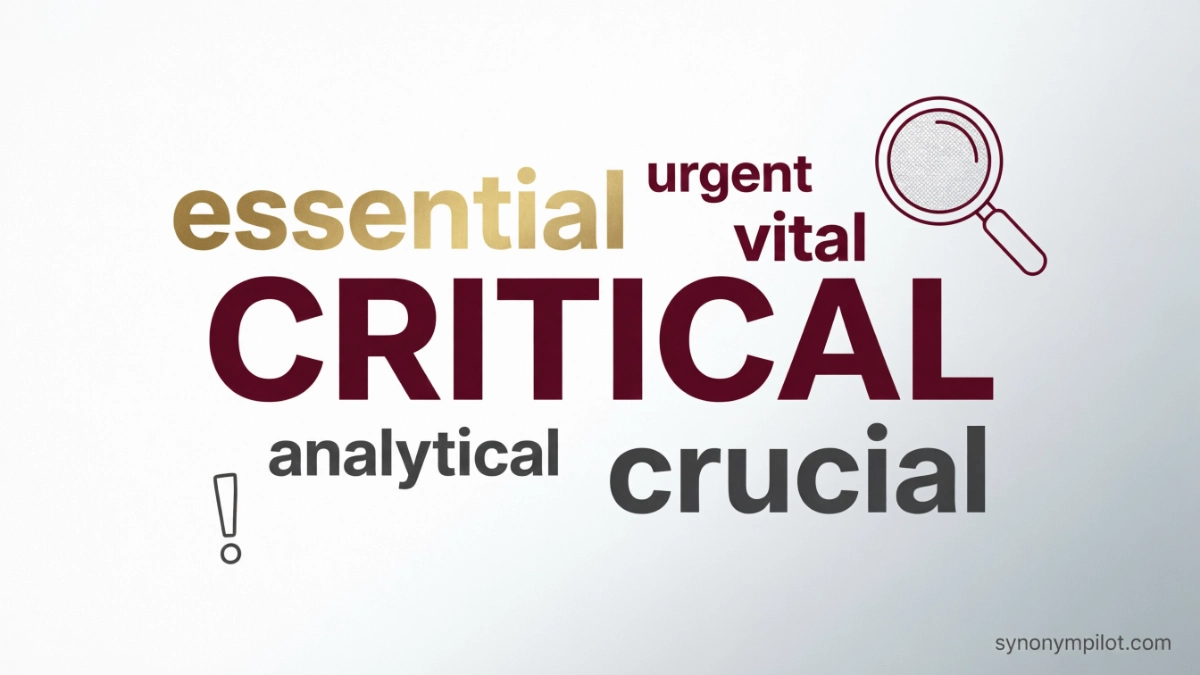
“Critical” means extremely important, urgent, or essential to a situation, or it can mean expressing disapproval and pointing out faults. It can also describe careful, analytical thinking. Words like “essential,” “vital,” or “judgmental” can replace “critical” depending on whether you mean importance, urgency, disapproval, or careful analysis.
Your doctor calls and says, “The test results are back, and the situation is critical we need to act quickly.” Your heart skips a beat.
Later that same day, your manager says, “Your feedback on the proposal was a bit too critical.” Same word, completely different meaning one signals urgency and danger, the other signals harsh judgment.
Understanding these different meanings of “critical” and knowing which synonym fits each one can prevent real confusion in both serious and everyday situations.
What Does “Critical” Mean?
“Critical” has several distinct meanings depending on context. It can describe something extremely important or urgent (a critical decision), something at a dangerous or decisive point (a critical condition), someone who points out faults or disapproves (a critical comment), or careful, analytical thinking (critical thinking). It is a word that changes meaning significantly based on context, which makes choosing the right synonym especially important.
Meaning, Tone, and Context
At its core, “critical” carries three main senses: urgency/importance, disapproval/fault finding, and analytical thinking. The tone shifts dramatically depending on which sense is intended.
In medical and emergency contexts, “critical” sounds serious and urgent “the patient is in critical condition” (formal, urgent, professional). In feedback or interpersonal contexts, “critical” often sounds negative “he was very critical of my work” (informal to professional, slightly negative). In academic contexts, “critical” often sounds analytical and positive “critical thinking is essential for this course” (academic, professional, neutral to positive).
Because “critical” can mean such different things, context is everything. A “critical review” of a book usually means a thoughtful, analytical review not necessarily a negative one, despite how the word might initially sound. Meanwhile, “he made a critical comment” almost always implies disapproval. Choosing the right synonym helps avoid this ambiguity entirely.
When and How to Use “Critical”
Use “critical” when you want to convey urgency, importance, disapproval, or analytical depth but be aware that the word’s meaning depends heavily on context, so make sure your sentence makes the intended meaning clear.
Here are natural examples across different situations:
- “The next twenty four hours are critical for the patient’s recovery.” (urgency, medical)
- “This is a critical decision for the company’s future.” (importance, professional)
- “She tends to be critical of other people’s work.” (disapproval, interpersonal)
- “The course focuses on developing critical thinking skills.” (analytical, academic)
When you want to avoid ambiguity, a more specific synonym “essential,” “judgmental,” “urgent,” or “analytical” communicates exactly which sense of “critical” you mean.
Another Word for Critical
If you need one quick, reliable alternative depending on context:
- For importance/urgency → essential, vital, or crucial
- For a dangerous or decisive moment → urgent or decisive
- For disapproval or fault finding → judgmental, disapproving, or fault finding
- For careful, analytical thinking → analytical or discerning
- For formal review or analysis → evaluative or discerning
There is no single “best” replacement for “critical” the right word depends entirely on which of its meanings you intend.
When Not to Use This Word
Avoid “critical” when you simply mean “important” in a low stakes situation. “It’s critical that we pick a restaurant for dinner” sounds overly dramatic for a casual decision. “It’s important that we pick a restaurant” fits better.
Avoid “critical” when you mean “negative” but want to soften your tone. “Your boss was critical of your presentation” can sound harsh. “Your boss had some constructive feedback” or “your boss pointed out a few areas to improve” softens the message while still being honest.
Avoid using “critical” in casual conversation when describing analytical thinking, since it can sound academic or stiff. “I need to think critically about this” works in academic or professional contexts, but in casual speech, “I need to really think this through” often sounds more natural.
Words Commonly Confused With Critical
Critical vs. Crucial:
Both describe something extremely important, but “crucial” tends to focus on importance for a specific outcome or decision, while “critical” can also describe danger, urgency, or fault finding. “This meeting is crucial for the project’s success” emphasizes importance to an outcome. “This meeting is critical” could also imply urgency or a high stakes moment.
Critical vs. Judgmental:
“Judgmental” specifically describes someone who forms negative opinions about others too quickly or harshly it’s almost always negative. “Critical” can describe fault finding too, but also has neutral or positive meanings (analytical thinking, important situations). “She’s very judgmental of others” is clearly negative. “She’s very critical of others” could mean the same, but “critical” has other neutral uses too.
Critical vs. Urgent:
“Urgent” focuses specifically on time sensitivity something needs immediate attention. “Critical” can describe urgency, but also importance without an immediate time pressure, or analytical depth without urgency at all. “This is urgent” means act now. “This is critical” might mean act now, or it might mean “this matters enormously,” without necessarily implying immediate action.
Critical vs. Analytical:
“Analytical” specifically describes a careful, logical approach to examining something. “Critical,” in phrases like “critical thinking,” means roughly the same thing, but “critical” can also describe negative judgment in other contexts, which “analytical” never does. “Analytical” is always neutral or positive; “critical” depends on context.
Best Synonym by Context
| Context | Best Synonym | Why It Fits |
|---|---|---|
| Medical / emergency | Serious, urgent, life-threatening | Clearly communicates danger and immediate risk |
| Business decisions | Essential, vital, crucial | Emphasizes importance to outcomes and success |
| Feedback / criticism | Judgmental, disapproving, fault-finding | Reflects negative evaluation or criticism |
| Academic analysis | Analytical, evaluative, discerning | Sounds logical, precise, and intellectual |
| Time-sensitive tasks | Urgent, pressing, time-sensitive | Highlights immediate need for action |
| Reviews (books, films) | Evaluative, analytical, discerning | Focuses on assessment rather than negativity |
| Everyday importance | Important, essential, key | Simple, clear, and widely understood |
| High-risk situations | Critical, severe, dire | Conveys extreme seriousness or danger |
| Decision impact | Crucial, decisive, pivotal | Shows strong influence on outcomes |
| Professional reporting | Significant, substantial, important | Neutral and formal tone for reports |
Which Synonym Should You Choose?
Ask yourself these quick questions before picking a replacement for “critical”:
1. Which meaning do you intend importance, danger, disapproval, or analysis? Each meaning has very different synonyms, and choosing the wrong one can completely change your sentence’s tone.
2. Is this about urgency or significance? “Urgent” and “pressing” focus on timing. “Essential” and “vital” focus on importance, regardless of timing.
3. Are you giving negative feedback? If so, “judgmental,” “disapproving,” or “fault finding” make the negative tone explicit useful when you want to be clear, but consider whether softer language (“constructive,” “evaluative”) might communicate your point more effectively.
4. Is this academic or casual? “Analytical” and “discerning” suit academic writing. “Important” and “key” suit everyday conversation.
Real Life Examples of “Critical” in Sentences
School:
“Developing critical thinking skills is one of the main goals of this course.”
“The final exam is critical for determining your overall grade this semester.”
Workplace:
“This deadline is critical missing it could affect the entire project timeline.”
“Her feedback during the review felt overly critical, even though she meant well.”
Writing:
“The critic offered a thoughtful, critical analysis of the film’s themes.”
“The article highlights several critical issues facing the healthcare system.”
Conversation:
“The next few days are critical for the team’s chances of making the playoffs.”
“He’s always so critical of everything nothing is ever good enough for him.”
50 Synonyms for “Critical”
| Synonym | Simple Meaning | Example Sentence |
|---|---|---|
| Essential | Absolutely necessary | Clean water is essential for survival. |
| Vital | Extremely important, often for survival or success | Sleep is vital for health. |
| Crucial | Extremely important for an outcome | Her vote was crucial to the decision. |
| Important | Having great significance | It is important to double-check your work. |
| Key | Central or most important | Communication is key to success. |
| Decisive | Strongly influencing the result | The decisive moment came in the final minute. |
| Urgent | Requires immediate attention | This is an urgent matter. |
| Pressing | Needing immediate attention | They discussed pressing issues. |
| Significant | Noticeably important | There has been significant progress. |
| Indispensable | Cannot be done without | Water is indispensable for life. |
| Pivotal | Central to outcome or change | The meeting was pivotal for the company. |
| Fundamental | Basic and essential | Trust is fundamental in relationships. |
| Imperative | Absolutely necessary | It is imperative to act quickly. |
| Paramount | Of highest importance | Safety is paramount in this job. |
| Life-threatening | Dangerous to life | The injury was life-threatening. |
| Serious | Important and requiring attention | This is a serious issue. |
| Severe | Very serious or extreme | The storm caused severe damage. |
| High-stakes | Involving great risk or consequence | It was a high-stakes negotiation. |
| Make-or-break | Decides success or failure | This project is make-or-break. |
| Judgemental | Forming negative opinions | He can be very judgemental. |
| Disapproving | Showing disapproval | She gave a disapproving look. |
| Fault-finding | Focusing on mistakes | Constant fault-finding hurts morale. |
| Censorious | Harshly critical (formal) | The review was censorious in tone. |
| Harsh | Severe or unkind | His feedback was harsh. |
| Negative | Expressing criticism | The comments were mostly negative. |
| Disparaging | Showing low opinion | His remarks were disparaging. |
| Scathing | Extremely critical | The article gave a scathing review. |
| Cutting | Sharp and hurtful | Her cutting remarks upset him. |
| Nitpicky | Overly focused on small details | He is nitpicky about formatting. |
| Analytical | Carefully logical and detailed | She has an analytical mindset. |
| Discerning | Showing good judgment | A discerning reader will notice details. |
| Evaluative | Involving assessment | The report includes evaluative comments. |
| Perceptive | Quick to understand | His perceptive feedback helped improve things. |
| Probing | Deep and investigative | The interviewer asked probing questions. |
| Penetrating | Deep insight or understanding | She gave a penetrating analysis. |
| Insightful | Showing clear understanding | His feedback was insightful. |
| Searching | Thorough and questioning | They asked searching questions. |
| Acute | Sharp and highly aware | She has an acute sense of detail. |
| Sensitive | Requiring careful handling | This is a sensitive issue. |
| Delicate | Needing tact and care | It was a delicate situation. |
| Precarious | Unstable or risky | The situation became precarious. |
| Dire | Extremely serious | The situation is dire. |
| Defining | Very influential moment | It was a defining decision. |
| Game-changing | Completely alters outcome | The innovation was game-changing. |
| Watershed | Major turning point | The election was a watershed moment. |
| Urgent priority | Must be done immediately | Fixing this is an urgent priority. |
| Top priority | Most important task | Safety is our top priority. |
| Mission-critical | Essential for operation success | The system is mission-critical. |
Synonym Groups & Usage Differences
Formal
Imperative, paramount, indispensable, censorious, evaluative, discerning suit formal writing, official reports, and academic contexts. These words sound precise and carry significant weight.
Informal
Nitpicky, make or break, game changing, top priority sound natural in everyday conversation and casual writing, especially when discussing decisions or feedback.
Academic
Analytical, discerning, evaluative, insightful, perceptive, penetrating appear frequently in academic writing, particularly when discussing critical thinking, analysis, and review.
Professional
Crucial, vital, essential, pivotal, mission critical, high stakes sound polished and appropriate for business communication, project management, and strategic discussions.
Conversational
Important, key, urgent, make or break, top priority are the most natural choices in spoken English and casual writing.
Strongest vs. Weaker
“Life threatening,” “dire,” and “mission critical” describe extremely serious situations far stronger than everyday “important.” “Significant” and “key” describe moderate importance, weaker than “critical” in urgent contexts.
Emotional vs. Neutral (Disapproval Sense)
“Scathing,” “cutting,” and “disparaging” carry strong negative emotional weight, often implying harshness or hurt feelings. “Evaluative,” “analytical,” and “discerning” remain neutral, focusing on careful judgment rather than harsh disapproval.
Antonyms of “Critical”
| Antonym | Meaning | Example Sentence |
|---|---|---|
| Unimportant | Not significant or worth attention | The issue is unimportant and won’t affect the outcome. |
| Trivial | Of little value or seriousness | They argued over a trivial mistake in the report. |
| Minor | Small or not serious | It was only a minor error that was quickly fixed. |
| Insignificant | Not important or meaningful | The difference was insignificant in the final results. |
| Nonessential | Not necessary or required | Those details are nonessential to the main argument. |
| Stable | Secure and not problematic | The system is stable and running smoothly now. |
| Positive | Showing approval or support | She gave a positive review of the proposal. |
| Approving | Expressing agreement or support | His approving smile encouraged the team. |
| Supportive | Giving help or encouragement | The teacher was supportive of every student’s effort. |
| Complimentary | Expressing praise | The comments about her work were highly complimentary. |
| Lenient | Not strict or harsh in judgment | The manager was lenient with the deadline. |
| Easygoing | Relaxed and not overly strict | He has an easygoing attitude toward small mistakes. |
| Uncritical | Accepting without judgment or analysis | He was uncritical of the information he received. |
| Accepting | Willing to approve or allow | She was accepting of different viewpoints. |
| Tolerant | Allowing differences without harsh judgment | The group was tolerant of opposing opinions. |
Comparison:
Critical vs. Related Words
These words often overlap with “critical,” but each carries a distinct emphasis depending on which sense of “critical” applies.
Critical vs. Crucial
“Crucial” focuses on importance for a specific outcome something that determines success or failure. “Critical” can mean the same thing, but also describes danger, urgency, or harsh judgment. “This step is crucial” emphasizes its role in the outcome. “This step is critical” could mean the same, but might also hint at risk if it goes wrong.
Critical vs. Urgent
“Urgent” is purely about time something needs attention right now. “Critical” can describe urgency, but also significance without immediate time pressure. “This task is urgent” means act now. “This task is critical” might mean it matters enormously, with or without an immediate deadline.
Critical vs. Judgmental
“Judgmental” almost always carries a negative tone quickly forming harsh opinions about people. “Critical” can describe fault finding too, but also has positive meanings (analytical thinking, important situations). Calling someone “judgmental” is more clearly an insult than calling their approach “critical,” which could be a compliment in academic contexts.
Critical vs. Analytical
“Analytical” is always neutral or positive describing careful, logical examination. “Critical,” especially in “critical thinking,” means something similar, but “critical” carries extra baggage from its negative sense (fault finding). In academic writing, “analytical” sometimes feels safer when you want to avoid any negative connotation.
Critical vs. Vital
“Vital” often relates to survival, health, or core function “vital signs,” “vital organs,” “vital information.” “Critical” is broader and can describe importance in any context, including business, academic, or interpersonal situations. “Vital” carries a slightly stronger sense of life or death necessity in many contexts.
Common Phrases and Expressions
“Critical mass” the minimum amount or number needed for something to succeed or take effect.
Example: “The campaign needed to reach critical mass on social media before it could go viral.”
“In critical condition” used in medical contexts to describe a patient whose life may be at risk.
Example: “The driver was taken to the hospital in critical condition after the accident.”
“Critical juncture” a particularly important moment or point in time, often where a decision must be made.
Example: “The company is at a critical juncture, deciding whether to expand internationally.”
“Constructive criticism” feedback intended to help someone improve, given in a helpful rather than harsh way.
Example: “Her manager offered constructive criticism that helped her improve the report significantly.”
“Make or break” a moment or decision that will determine success or failure.
Example: “This client meeting could be make or break for the company’s future.”
“Read between the lines” to understand a deeper or hidden meaning, related to critical thinking and analysis.
Example: “If you read between the lines of his email, you can tell he’s not happy with the decision.”
Common Mistakes to Avoid
Using “critical” without clarifying which meaning you intend:
“His comments were critical” could mean his comments were extremely important, or that they were negative and judgmental. Adding context “his comments were critical of the proposal” or “his comments were critical to the discussion” removes ambiguity.
Confusing “critical” with “judgmental” in feedback contexts:
Calling someone’s feedback “critical” doesn’t always mean it was harsh in academic and professional settings, “critical analysis” is often a compliment, implying thoughtful evaluation. Assuming “critical” always means “negative” can lead to misunderstandings.
Overusing “critical” for low stakes situations:
“It’s critical that we choose the right font for this slide” sounds overly dramatic. “It’s important” or “it would help” fits better for minor decisions, reserving “critical” for situations with real consequences.
Using “vital” interchangeably with “critical” in non survival contexts:
“Vital” often implies life or death importance or core function. “This software update is vital” can sound exaggerated if the update is minor. “Important” or “useful” might be more accurate, depending on the actual stakes.
Mistaking “critical thinking” for “negative thinking”:
“Critical thinking” describes careful, logical analysis not negativity or fault finding. Students sometimes assume “being critical” in academic writing means being harsh, when it actually means being thoughtful and analytical.
FAQs
What is the difference between “critical” and “crucial”?
A: “Crucial” focuses specifically on importance for a particular outcome something that determines success or failure. “Critical” can mean the same thing, but also describes danger, urgency, or harsh judgment, depending on context. They overlap significantly when discussing importance, but “critical” has additional meanings “crucial” doesn’t share.
Does “critical” always mean negative?
A: No. “Critical” has multiple meanings. In phrases like “critical thinking” or “critical analysis,” it describes careful, thoughtful evaluation often positive. In phrases like “he was very critical of my work,” it usually implies disapproval. Context determines which meaning applies.
What is a synonym for “critical” in a medical emergency?
A: “Serious,” “life threatening,” and “urgent” all work well in medical contexts. “The patient is in critical condition” is the standard medical phrase, but “the patient is in serious condition” or “the situation is life threatening” convey similar urgency.
What is the difference between “critical” and “important”?
A: “Important” describes general significance. “Critical” often implies a higher level of urgency, risk, or consequence something that could fail or go wrong if not addressed. Not everything important is critical, but everything critical is important.
How can I describe negative feedback without sounding too harsh?
A: Instead of saying feedback was “critical” (which can sound negative), try “constructive,” “detailed,” or “thorough.” “She gave constructive feedback on my draft” sounds more positive than “she was critical of my draft,” even if the content of the feedback is similar.
Conclusion
“Critical” is one of those words that changes meaning dramatically depending on context sometimes describing urgency, sometimes importance, sometimes disapproval, and sometimes careful analysis.
Understanding which sense applies in each situation helps you choose synonyms that communicate exactly what you mean, without confusion.
This week, pay attention to how you use “critical” in conversation or writing. Ask yourself: do I mean urgent, important, judgmental, or analytical?
Then try a more specific word from this article “essential,” “judgmental,” “analytical,” or “urgent” depending on which meaning fits. With practice, you’ll find these distinctions becoming second nature, making your English clearer and more precise in every situation.

Hi, I’m Camron White, a word lover who enjoys exploring the beauty of the English language. I write about synonyms, meanings, and everyday vocabulary to help readers express themselves more clearly and confidently. My goal is to make learning new words simple, fun, and useful in real-life conversations. synonympilot.com