Quick Answer:
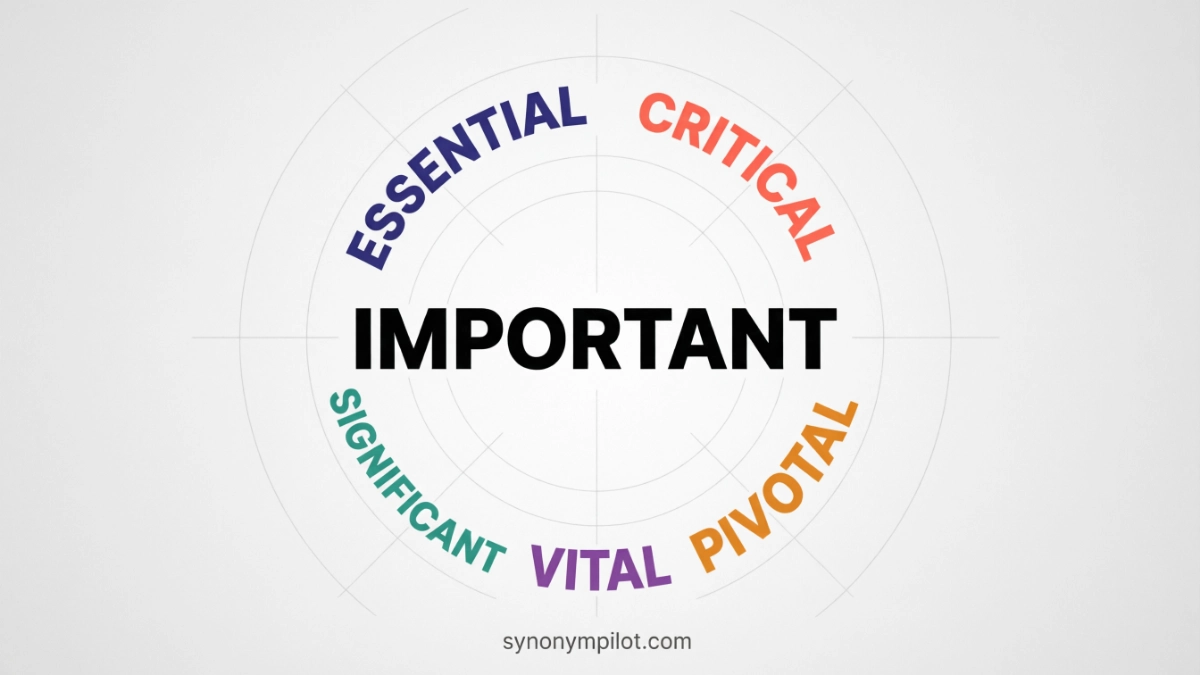
Important means something that has great value, significance, or influence and deserves serious attention. It describes things that matter if that’s a decision, a person, a deadline, or an idea.
You can use it in almost any situation, from casual conversation to formal writing, though stronger or more specific synonyms often communicate your meaning more precisely.
Meaning, Tone & Context
At its core, important signals that something carries weight it affects outcomes, holds value, or demands attention. The word itself is neutral in tone, which makes it incredibly flexible. You can drop it into a text message (“This is important!”) or a business report (“This finding is important to our strategy”) and it works both times.
That flexibility, however, is also its weakness. Because important fits everywhere, it can feel vague or generic especially in academic writing, professional communication, or persuasive content where precision matters. That’s why knowing its synonyms genuinely improves your writing and speaking.
Tone wise, important leans slightly formal compared to words like big or major, but it’s far less stiff than critical, paramount, or imperative. Think of it as the comfortable middle ground professional without being cold, clear without being blunt.
When and How to Use “Important”
Use important when you want to signal that something deserves attention without overstating urgency. It works well in:
- Giving instructions: “There’s one important step you must not skip.”
- Highlighting priorities: “Time management is important in every job.”
- Academic writing: “This distinction is important for understanding the theory.”
- Everyday conversation: “I have something important to tell you.”
However, when the context demands stronger emphasis a deadline, a safety issue, or a core argument words like critical, vital, or essential carry more force and serve you better.
Another Word for Important
Looking for a direct substitute? Here are the strongest single word alternatives depending on what you need:
- For urgency → critical, urgent, pressing
- For necessity → essential, vital, indispensable
- For significance → significant, consequential, meaningful
- For priority → primary, paramount, chief
- For formal writing → pivotal, fundamental, substantial
- For conversation → big, major, key
When Not to Use This Word
Avoid important when:
- You’ve already used it two or three times in the same paragraph repetition weakens impact.
- The context calls for emotional weight. “Your support is important to me” sounds flat compared to “Your support means everything to me.”
- You’re writing academic or professional content that requires precision. “This factor is important” tells readers little; “This factor is decisive” tells them exactly what you mean.
- You want to show urgency. “This is important” is weaker than “This is urgent” or “This is critical.”
Words Commonly Confused with Important
Several words overlap with important but differ in subtle yet significant ways:
Important vs. Significant
Significant suggests something has measurable or notable impact, often backed by evidence. Important is more general. Scientists write “a statistically significant result,” not “a statistically important result.”
Important vs. Essential
Essential means something is absolutely necessary you cannot function without it. Important is strong, but essential leaves no room for debate.
Important vs. Critical
Critical implies that failure or serious harm could follow if something is neglected. “Oxygen is critical to survival” expresses life or death necessity. Important doesn’t carry that weight.
Important vs. Relevant
Relevant means related or applicable to the topic at hand. Something can be relevant without being important, and vice versa.
Best Synonym by Context
| Context | Best Synonym | Why It Works |
|---|---|---|
| Medical or safety | Critical / Vital | Signals urgency and necessity |
| Academic writing | Significant / Pivotal | Precise, evidence-based tone |
| Business email | Key / Essential | Clear, professional, and concise |
| Everyday talk | Big / Major | Natural and conversational |
| Emotional context | Meaningful / Precious | Adds personal weight and feeling |
| Law or policy | Material / Paramount | Formal and authoritative |
| Teaching or learning | Fundamental / Core | Shows foundational importance |
| Deadlines or tasks | Urgent / Pressing | Communicates time sensitivity |
Which Synonym Should You Choose?
The right word depends on two things: how strong you want the message to be, and how formal the setting is.
If you’re writing a casual message, big or major feel natural. If you’re submitting an essay, significant or pivotal sound more polished. If something truly cannot be missed or skipped, reach for essential, vital, or critical these leave no doubt about the stakes.
As a general rule, avoid defaulting to important when a more specific word is available. Specificity signals confidence and makes your writing more persuasive and professional.
Real Life Examples of “Important” in Sentences
School:
- “Reading comprehension is an important skill that affects every subject you study.”
- “The teacher reminded students that the final exam covers all important topics from the semester.”
Workplace:
- “Clear communication is important in any team environment.”
- “Please review the attached report it contains important updates from the finance department.”
Writing:
- “The author makes an important distinction between correlation and causation.”
- “This chapter introduces the most important concept of the entire book.”
Conversation:
- “Hey, I need to talk to you about something important.”
- “She made an important point that changed how everyone saw the situation.”
50 Synonyms for Important
| Synonym | Simple Meaning | Example Sentence |
|---|---|---|
| Significant | Having notable impact or meaning | The study found a significant link between sleep and memory. |
| Essential | Absolutely necessary | Water is essential for all living things. |
| Critical | Extremely important; urgent | It’s critical that you back up your files regularly. |
| Vital | Necessary for life or success | Exercise plays a vital role in mental health. |
| Key | Most important factor | Communication is the key factor in any relationship. |
| Pivotal | Turning point or decisive | That decision was pivotal in the company’s growth. |
| Fundamental | Basic and necessary | Trust is fundamental to any strong friendship. |
| Primary | First in importance | Safety is our primary concern. |
| Major | Large in importance or impact | She made a major contribution to the research. |
| Central | At the core of something | This idea is central to the argument. |
| Paramount | Of highest importance | Patient safety is paramount in healthcare. |
| Pressing | Needing immediate attention | We have a pressing deadline. |
| Urgent | Requires quick action | The situation is urgent. |
| Consequential | Having serious effects | This is a highly consequential decision. |
| Meaningful | Having value or purpose | She gave a meaningful speech. |
| Noteworthy | Worth attention | His progress has been noteworthy. |
| Notable | Clearly important | The report highlighted notable findings. |
| Substantial | Large and significant | There has been a substantial improvement. |
| Serious | Important; not minor | This is a serious issue. |
| Weighty | Of great consequence | They faced a weighty decision. |
| Indispensable | Cannot be done without | A good mentor is indispensable. |
| Necessary | Required | It is necessary to review the report. |
| Relevant | Closely connected | Only relevant details should be included. |
| Influential | Has strong effect | She is an influential leader. |
| Powerful | Strong effect or authority | His words were powerful. |
| Decisive | Strong determining effect | Her evidence was decisive. |
| High priority | Very important task | This is a high priority task. |
| Prominent | Stands out as important | Climate change is a prominent issue. |
| Distinguished | Highly respected and important | He is a distinguished scholar. |
| Momentous | Very significant event | It was a momentous occasion. |
| Life-changing | Deep impact on life | Studying abroad was life-changing. |
| Far-reaching | Wide effects | The policy has far-reaching effects. |
| Exceptional | Unusually important or good | The team delivered exceptional results. |
| Non-negotiable | Cannot be changed | Honesty is non-negotiable here. |
| Overriding | Most important above all | Safety is the overriding concern. |
| Imperative | Absolutely required | It is imperative to act now. |
| Landmark | Historically important | This was a landmark decision. |
| Grave | Very serious | The doctor delivered grave news. |
| Foundational | Forms the basis | Reading is a foundational skill. |
| Irreplaceable | Cannot be replaced | Her expertise is irreplaceable. |
| Valued | Highly respected | Your input is valued. |
| Material | Legally or practically important | This is a material fact in the case. |
| Salient | Most important point | The report highlights salient risks. |
| Of note | Worth attention | Several points of note were raised. |
| Mission-critical | Essential for operation | This system is mission-critical. |
| Top-tier | Highest level importance | This is a top-tier priority. |
| Core | Central to purpose | Integrity is a core value. |
| Strategic | Important for long-term plan | This is a strategic decision. |
| Big | Informally very important | We have a big announcement. |
Synonym Groups and Usage Differences
Formal Synonyms
Words like paramount, imperative, pivotal, consequential, and indispensable belong in professional reports, academic papers, legal writing, and formal speeches. They signal careful, precise thinking and suit audiences who expect elevated language.
Informal and Conversational Synonyms
In everyday speech and casual writing, big, major, key, and serious feel natural and approachable. These work well in text messages, team chats, emails to friends, or spoken conversation.
Academic Synonyms
Significant, fundamental, salient, material, and noteworthy are the go to choices in essays, research papers, and academic writing. They suggest the writer is making a measured, evidence based claim rather than a personal judgment.
Professional and Business Synonyms
In workplace communication, critical, essential, high priority, strategic, and mission critical communicate stakes clearly without sounding dramatic. They’re direct and efficient exactly what busy professionals need.
Strongest vs. Weaker Synonyms
Paramount, imperative, indispensable, and vital are the strongest they leave almost no room for doubt. Notable, relevant, noteworthy, and of note are softer they highlight something without insisting on its absolute priority.
Emotional vs. Neutral Synonyms
Meaningful, life changing, precious, and irreplaceable carry emotional depth and personal connection. In contrast, significant, material, and strategic are cooler and more analytical. Choose based on whether your message is personal or professional.
Modern vs. Old Fashioned Synonyms
Mission critical, high priority, and top tier are modern, especially in business contexts. Weighty, grave, and paramount have a more classical, formal feel that still works in serious writing but may sound stiff in casual settings.
Antonyms of Important
| Antonym | Meaning | Example Sentence |
|---|---|---|
| Unimportant | Lacking significance | That detail is unimportant in this context. |
| Trivial | Very minor or of little value | Don’t waste time on trivial matters. |
| Insignificant | Too small to matter | The error was insignificant and easily fixed. |
| Irrelevant | Not related or applicable | That point is irrelevant to our discussion. |
| Minor | Small in importance | It was just a minor mistake. |
| Negligible | So small it can be ignored | The effect was negligible. |
| Petty | Small-minded or unimportant | They argued over petty issues. |
| Peripheral | Not central or important | That issue is peripheral to our main goal. |
| Inconsequential | Having no real effect | The change was inconsequential. |
| Dispensable | Not necessary | These features are dispensable in the basic version. |
Comparison Section
Important vs. Critical
Critical raises the stakes dramatically. “This step is critical” implies that skipping it causes failure or harm. “This step is important” simply says it matters. Use critical for high risk situations; use important for general priorities.
Important vs. Essential
Essential removes any sense of choice it’s required, full stop. “Sleep is essential” is stronger than “Sleep is important.” When something is truly non negotiable, essential is the better word.
Important vs. Significant
These two are often interchangeable in casual writing, but significant is more precise. It suggests measurable, observable impact which is why scientists and researchers prefer it. “A significant increase” implies data; “an important increase” implies judgment.
Important vs. Urgent
Important refers to value; urgent refers to timing. Something can be important but not urgent (planning for retirement) or urgent but not very important (a minor form that’s overdue). Urgent always implies a time sensitive element.
Important vs. Relevant
Relevant means connected to the topic. Important means it carries weight. A piece of evidence can be relevant without being decisive it belongs to the discussion, but it may not change the outcome.
Common Phrases and Expressions with “Important”
1. “Of the utmost importance”
Means something is absolutely the most important matter. Often used in formal communication. Example: “It is of the utmost importance that all participants sign the waiver before entering.”
2. “It’s important to note that…”
A phrase used to draw attention to a key point, especially in academic or professional writing. Example: “It’s important to note that these results apply only to the study group.”
3. “More importantly”
A transition phrase used to introduce a stronger or more significant point. Example: “The project was completed on time but more importantly, it came in under budget.”
4. “Most importantly”
Used to introduce the single most significant point in a series. Example: “He is talented, experienced, and most importantly, trustworthy.”
5. “Play an important role”
Describes something that contributes significantly to a process or outcome. Example: “Parents play an important role in early childhood development.”
6. “On an important note”
Used to shift the conversation or writing to a significant point. Example: “On an important note, please remember to submit your forms before Friday.”
7. “An important milestone”
Refers to a key achievement or turning point in a process. Example: “Graduating was an important milestone in her professional journey.”
Common Mistakes to Avoid
Overusing “important”
Writing “This is an important point about an important topic that has important implications” drains the word of all meaning. Replace repeated uses with varied synonyms.
Using “important” when you mean “urgent”
“This email is important” is vague. “This email is urgent please respond today” is clear. Don’t confuse importance (value) with urgency (timing).
Choosing “vital” or “critical” for minor things
Using strong words for small matters backfires. If everything is “critical,” nothing feels critical. Reserve high intensity synonyms for situations that genuinely deserve them.
Confusing “significant” with “important” in academic writing
In research contexts, significant often has a technical meaning (especially in statistics). Use it carefully and consistently, and don’t substitute important when a technical term is expected.
Treating “relevant” and “important” as identical
Relevant means connected to the topic. Important means it carries weight or value. A piece of information can easily be one without being the other.
FAQs
What is the most formal synonym for “important”?
A: Paramount, imperative, and indispensable are among the most formal. They work well in legal documents, official reports, and academic writing where you want to convey absolute priority without any ambiguity.
What’s a good single word alternative to “important” in an essay?
A: Significant is the most widely accepted academic alternative. It sounds precise and measured, which suits essay writing well. Pivotal and fundamental are also strong choices depending on your meaning.
Can I use “vital” and “essential” interchangeably?
A: They’re very close in meaning, but vital often has a biological or life sustaining connotation (“vital organs,” “vital signs”), while essential is more flexible and works in any context where something is strictly necessary. In most cases, both work just be aware of the slight difference in feel.
What’s the difference between “important” and “relevant”?
A: Important tells you something has value or deserves attention. Relevant tells you something is connected to the matter at hand. A fact can be relevant (related) without being important (significant), and vice versa.
Is “crucial” stronger than “important”?
A: Yes. Crucial implies that a negative outcome is likely if something is ignored or omitted. It suggests higher stakes than important. Think of crucial as important + consequence. Use it when failure is genuinely a concern.
Conclusion
Knowing just one word for something rarely gets you far in communication. The difference between saying “this is important” and “this is critical” can change how someone reads your email, understands your essay, or responds to your request. Synonyms aren’t just decoration they’re tools for precision, tone, and impact.
So rather than reaching for important by habit, take a moment to consider what you actually mean. Is something urgent? Say urgent. Is it truly necessary?
Say essential. Is it a turning point? Say pivotal. The more intentional you are with your word choices, the more confident and convincing you’ll sound in writing and in conversation alike.

Hi, I’m Theo John, a passionate word explorer who loves diving into the beauty of the English language. I write about synonyms, word meanings, and practical vocabulary tips to help readers communicate with confidence. synonympilot.com