You’re updating your CV and you’ve written “five years of experience in marketing” then realized you used “experience” three more times in the next two paragraphs.
Or you’re writing a personal statement and you want to describe a life changing trip, an internship, or a difficult season you grew through, but “experience” feels too generic for something that actually mattered.
That’s the exact moment when knowing the right synonym transforms good writing into something genuinely precise and memorable.
“Experience” is one of the most versatile and overworked nouns in the English language and that versatility is both its strength and its biggest problem.
Quick Answer: What Does “Experience” Mean?
“Experience” is a noun that refers to knowledge, skill, or understanding gained through doing or living through something over time. It also describes a specific event or situation that someone goes through something that happens to them and affects them in some way. You can use it to describe professional background, personal history, or a single memorable moment.
Meaning, Tone & Context
“Experience” carries two distinct core meanings that are worth keeping separate.
The first is accumulated knowledge or skill the kind you build up over time through practice, work, and living: “She has ten years of experience in finance.” This sense is professional, measurable, and highly valued in workplace and academic contexts.
The second is a specific event or episode something that happens to you and that you feel, remember, or learn from: “Traveling alone for the first time was a transformative experience.” This sense is more personal, narrative, and emotional.
Tone wise, “experience” works across every register formal reports, academic essays, job applications, personal essays, and casual conversation. That broad reach is exactly why it appears everywhere and why knowing its synonyms matters so much. Related word forms: experienced (adjective “an experienced surgeon”), experiential (adjective “experiential learning”), and inexperienced (opposite “an inexperienced candidate”).
When & How to Use “Experience”
Use “experience” when describing either accumulated professional knowledge or a specific personal event and be clear about which meaning you intend, because they call for different synonyms.
Realistic examples:
- “He has extensive experience managing large teams across multiple countries.” (professional skill)
- “Living abroad was the most formative experience of her twenties.” (personal event)
- “The user experience on this app needs significant improvement.” (designed interaction)
- “I don’t have direct experience in this area, but I learn quickly.” (professional background)
So the context professional, personal, or product related should guide your synonym choice every time.
Another Word for “Experience”
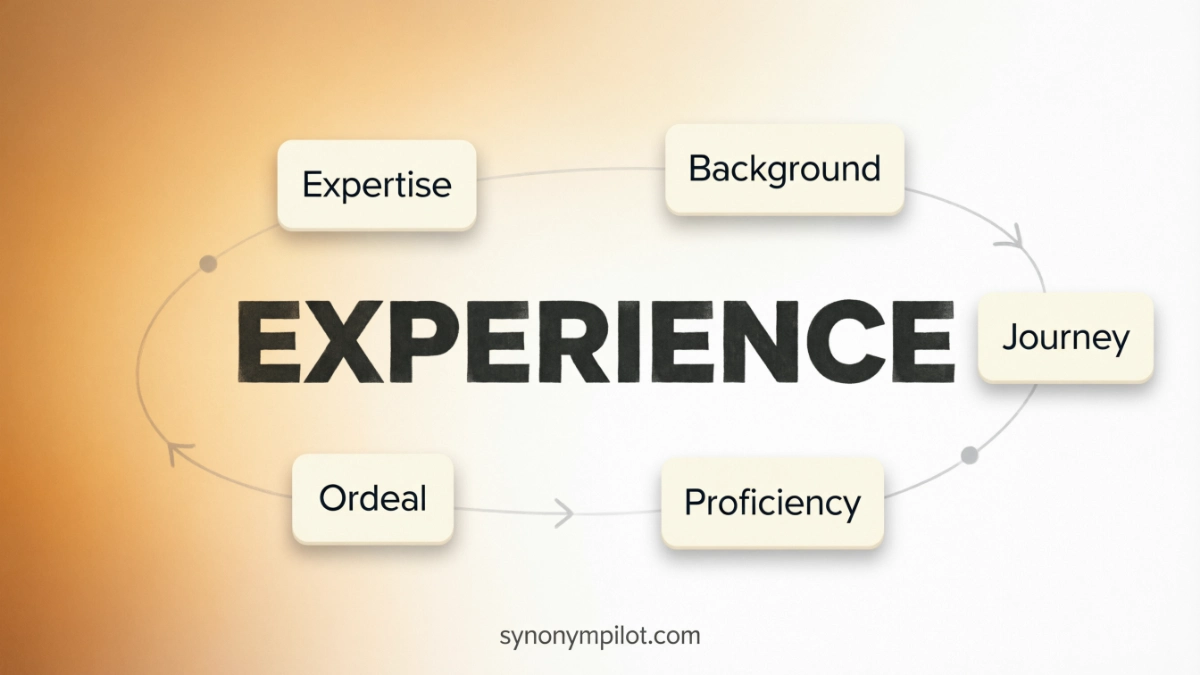
The best single replacement depends entirely on which meaning you’re using. For professional accumulated knowledge, expertise or background are the strongest clean substitutes. For a specific personal event or episode, encounter, episode, or ordeal each add specific emotional texture. For something transformative and deeply felt, journey and passage work beautifully in personal writing. And for the designed, product related sense, interaction or engagement are both precise and contemporary.
When Not to Use “Experience”
Avoid “experience” in professional writing when you actually mean a specific, named skill set in those cases, expertise, proficiency, or competence are more precise and credible. Saying “I have experience in data analysis” is fine, but “I have proficiency in data analysis tools” is sharper on a CV.
Also avoid using “experience” as a vague substitute for actual description in personal writing. “It was an incredible experience” tells the reader almost nothing. What kind of experience? Emotionally overwhelming? Physically demanding? Intellectually challenging? Replacing “experience” with a more specific noun ordeal, revelation, adventure, milestone forces you to be more precise and makes your writing immediately stronger.
Words Commonly Confused With “Experience”
Many writers treat “experience,” “expertise,” “knowledge,” “skill,” and “background” as interchangeable but each carries a meaningfully different emphasis. “Expertise” implies a high and recognized level of mastery, not just time served. “Knowledge” is information held in the mind, not necessarily from doing. “Skill” is a specific, practiced ability. “Background” describes the overall context of someone’s history and training. “Practice” implies repeated action toward improvement. Choosing the right one immediately sharpens your sentence.
Best Synonym by Context (Experience)
| Context | Best Synonym | Why It Works |
|---|---|---|
| CV / job application (professional skill) | Expertise / Background / Track record | Highlights proven ability and professional value |
| Academic writing | Knowledge / Proficiency / Competence | Formal and precise tone used in research |
| Personal essay (specific event) | Encounter / Episode / Chapter | Focuses on individual moments or events |
| Storytelling / creative writing | Journey / Ordeal / Passage | Adds emotional depth and narrative flow |
| Product / tech / UX writing | Interaction / Engagement / Interface | Matches user-system interaction language |
| Describing professional history | Background / Career / Record | Standard professional terminology |
| Emotional or transformative event | Revelation / Awakening / Turning point | Emphasizes change and personal growth |
| Describing a difficult event | Ordeal / Trial / Challenge | Reflects struggle and hardship |
| Describing a positive memorable event | Adventure / Discovery / Highlight | Conveys excitement and positivity |
| Describing accumulated wisdom | Wisdom / Insight / Seasoning | Suggests growth over time and maturity |
Which Synonym Should You Choose?
First, identify whether “experience” means accumulated knowledge or a specific event. For knowledge and skill, ask: how deep is it? Expertise implies mastery; background implies history; proficiency implies solid competence. For a specific event, ask: what was the emotional quality? An ordeal was difficult. An adventure was exciting. A revelation changed your thinking. A milestone marked progress. That emotional texture is what your synonym should capture and “experience” alone almost never does.
Real Life Examples of “Experience” in Sentences
School
“Her background in behavioral psychology gave her a significant advantage in the research module.”
Workplace
“His expertise in supply chain management proved invaluable during the restructuring.”
Writing
“That year in the mountains was less a holiday than an ordeal beautiful, brutal, and completely necessary.”
Conversation
“Honestly, the whole thing was such a journey I came back a completely different person.”
50 Synonyms for Experience
| Synonym | Simple Meaning | Example Sentence |
|---|---|---|
| Expertise | Deep mastery in a subject | Her expertise in law made her the top choice. |
| Background | Overall history of work or training | His background in engineering suited the role. |
| Knowledge | Information gained through learning | She brought strong knowledge of the market. |
| Skill | Practiced ability | His skill in design improved the product. |
| Proficiency | Competent level of ability | She showed proficiency in coding. |
| Competence | Ability to perform well | The team demonstrated strong competence. |
| Know-how | Practical understanding | He had the technical know-how to fix it. |
| Wisdom | Deep understanding from experience | She led with quiet wisdom. |
| Insight | Deep understanding of a situation | The consultant provided valuable insight. |
| Track record | History of performance | His track record was excellent. |
| Encounter | A specific experience or meeting | Her encounter changed her perspective. |
| Episode | A distinct life event | That episode shaped her career. |
| Event | Something that happens | The trip became a memorable event. |
| Incident | Notable happening | The incident taught him a lesson. |
| Occurrence | Something that happens | It was a rare occurrence. |
| Ordeal | Difficult experience | The flood was a terrible ordeal. |
| Trial | Testing experience | The exam year was a real trial. |
| Adventure | Exciting experience | The journey was a great adventure. |
| Journey | Life process of change | Starting the business was a journey. |
| Passage | Transition period | It marked a passage in her life. |
| Chapter | Life phase | That was an important chapter. |
| Phase | Stage of development | Her career entered a new phase. |
| Period | Time span in life | That period shaped his thinking. |
| Stint | Fixed period of work | Her stint abroad was valuable. |
| Tour of duty | Service period | His tour shaped his worldview. |
| Apprenticeship | Learning period under guidance | His apprenticeship built his skills. |
| Training | Skill development process | Her training was intensive. |
| Education | Formal or informal learning | His education shaped his career. |
| Exposure | Contact with new things | Early exposure helped him grow. |
| Immersion | Deep involvement | Immersion improved her fluency. |
| Practice | Repeated skill use | Practice made her confident. |
| Discipline | Structured effort | Discipline shaped his success. |
| Craft | Developed artistic skill | He refined his craft over years. |
| Mastery | Complete control of skill | She achieved mastery in law. |
| Command | Strong control or knowledge | He had command of the subject. |
| Familiarity | Comfortable knowledge | Her familiarity helped the team. |
| Acquaintance | Basic knowledge | His acquaintance with rules helped. |
| Grounding | Strong foundation | She had grounding in science. |
| Foundation | Basic support knowledge | Training gave her a foundation. |
| Record | Documented history | Her record was impressive. |
| History | Personal past events | His history was well known. |
| Portfolio | Collection of work | Her portfolio stood out. |
| Résumé | Career summary | His résumé showed strong growth. |
| Credential | Qualification proof | Her credentials were strong. |
| Achievement | Successful accomplishment | Each achievement built her career. |
| Revelation | Life-changing realization | It was a personal revelation. |
| Awakening | New awareness | The trip caused an awakening. |
| Turning point | Direction-changing moment | It was a turning point in life. |
| Milestone | Major progress point | Her first job was a milestone. |
| Discovery | Finding something new | The internship was a discovery. |
Synonym Groups & Usage Differences
sional vs. Personal
For professional contexts CVs, cover letters, performance reviews, LinkedIn profiles the strongest synonyms are expertise, background, track record, proficiency, competence, mastery, and know how. These sound credible, measurable, and results oriented. For personal writing memoirs, personal essays, college applications, storytelling journey, ordeal, revelation, chapter, encounter, and turning point carry emotional depth and narrative power that “experience” alone never provides.
Formal vs. Conversational
Formal alternatives include expertise, proficiency, competence, mastery, credential, grounding, and immersion clean and authoritative for reports, academic writing, and official documents. Conversational alternatives like know how, stint, journey, background, chapter, and phase feel natural and human in everyday speech, casual emails, and informal writing.
Strongest vs. Weaker
At the strongest end, mastery, expertise, command, and wisdom describe deep, earned, irreplaceable knowledge. In the middle, proficiency, competence, background, and track record describe solid, reliable capability. At the gentler end, familiarity, acquaintance, exposure, and grounding describe early stage or partial knowledge useful when you want to acknowledge awareness without overclaiming depth.
Emotional vs. Neutral
Emotional synonyms revelation, awakening, ordeal, turning point, journey, passage describe how an experience felt and what it meant. They carry personal weight and belong in storytelling, personal essays, and speeches. Neutral synonyms occurrence, incident, episode, event, period describe something that happened without adding emotional color. These fit journalism, professional reports, and factual writing.
Antonyms of “Experience”
| Antonym | Meaning | Example Sentence |
|---|---|---|
| Inexperience | Lack of knowledge or skill | His inexperience in the role showed in the first week. |
| Ignorance | Lack of knowledge or awareness | His ignorance of local culture caused misunderstandings. |
| Naivety | Lack of worldly experience | Her naivety faded as she gained industry exposure. |
| Incompetence | Lack of ability to perform well | The failure was due to management incompetence. |
| Rawness | Being untrained or undeveloped | The rawness of the recruit was clear but promising. |
| Amateurism | Lack of professional skill | The report showed clear amateurism. |
| Unfamiliarity | Lack of knowledge or comfort | His unfamiliarity with the system slowed progress. |
| Greenness | Being new and inexperienced | Her greenness was obvious but improving quickly. |
Comparison: Experience vs. Similar Words
Experience vs. Expertise
“Experience” tells you how long someone has been doing something. “Expertise” tells you how well they do it. You can have years of experience without reaching expertise and rare individuals develop genuine expertise relatively quickly. On a CV, “expertise” makes a stronger and more confident claim than “experience.” Use “experience” when emphasizing time and breadth; use “expertise” when emphasizing depth and mastery.
Experience vs. Knowledge
“Knowledge” lives in the mind it’s information, theory, and understanding. “Experience” comes from doing it’s practical, felt, and tested. A medical student has knowledge; a seasoned doctor has experience. Both matter, but in most professional contexts, demonstrated experience carries more weight than theoretical knowledge alone.
Experience vs. Background
“Background” refers to the overall context of someone’s professional or educational history where they’ve been, what they’ve done, and what shaped them. “Experience” refers to specific skills or events within that history. Your background is the whole picture; your experience is what you draw from within it. “Background” often sounds slightly more personal and narrative; “experience” is more focused and practical.
Experience vs. Encounter
“Encounter” describes a specific, often brief or unexpected contact with someone or something. “Experience” is broader and can span any length of time. You have an encounter with a strange situation; you gain experience over years of working in it. Use “encounter” when the singularity and immediacy of the event matters.
Experience vs. Ordeal
“Ordeal” specifically describes a difficult, painful, or stressful experience that tests a person. It’s emotionally loaded in a way that “experience” is not. Use “ordeal” only when the experience genuinely involved hardship, struggle, or suffering using it for mild inconveniences overstates the case and weakens the word.
Common Phrases & Expressions
1. Hands on experience
Meaning: Practical, direct experience doing something not just reading or observing.
“The internship gave her genuine hands on experience in a real working newsroom.”
2. A learning experience
Meaning: A situation often difficult that teaches you something valuable.
“Losing the pitch was painful, but everyone agreed it was a real learning experience.”
3. Years of experience
Meaning: A professional way of indicating accumulated time and knowledge in a field.
“With over fifteen years of experience in corporate law, she handled the case with ease.”
4. First hand experience
Meaning: Experience gained directly by doing or living through something yourself.
“He had first hand experience of the refugee crisis that no briefing document could replicate.”
5. Live and learn
Meaning: A phrase acknowledging that mistakes and difficult experiences teach you important lessons.
“The project didn’t go as planned but as they say, live and learn.”
6. Draw on experience
Meaning: To use past knowledge or events to help you deal with a current situation.
“In the negotiation, she drew on experience from three previous deals to find a solution.”
Common Mistakes to Avoid
1. Using “experience” when you mean “expertise”
“I have experience in this field” and “I have expertise in this field” sound similar but make very different claims. “Experience” says you’ve spent time in it. “Expertise” says you’ve mastered it. On a CV or in a professional context, be honest about which claim you’re actually making.
2. Treating “knowledge” and “experience” as synonyms
Knowledge is theoretical; experience is practical. A recent graduate has knowledge. A veteran has experience. Using them interchangeably blurs an important distinction that most professional readers notice immediately.
3. Describing emotional events as simply “an experience”
When something genuinely moved, challenged, or transformed you, calling it “an experience” is a lost opportunity. Use ordeal, revelation, turning point, or journey whichever captures the actual emotional quality. Vague language weakens personal writing.
4. Overusing “experience” in CVs and cover letters
Reading “I have experience in… experience with… my experience shows…” in a job application signals weak vocabulary. Rotate between background, expertise, track record, proficiency, and competence to show range and precision.
5. Using “encounter” and “experience” interchangeably
“Encounter” suggests something brief, specific, and often unexpected. “Experience” is broader and can cover years. Using “encounter” for something long term undersells its depth; using “experience” for something fleeting makes it sound more deliberate than it was.
FAQs
What’s the best synonym for “experience” on a CV or resume?
“Expertise” works best when claiming deep mastery. “Background” suits professional history. “Track record” emphasizes proven results. “Proficiency” signals solid competence in specific skills. Rotating between these makes your application sound more precise and professional.
What is a good word for “experience” in a personal essay?
Choose based on what kind of experience it was. A difficult one: ordeal or trial. A transformative one: turning point or revelation. An exciting one: adventure or journey. A significant one: milestone or chapter. Any of these will create far more impact than the generic “experience.”
Is “expertise” always stronger than “experience”?
In professional contexts, yes “expertise” makes a bigger claim and implies mastery rather than just time spent. However, “experience” can be the more honest and appropriate word if you haven’t yet reached a level of genuine mastery. Use the word that accurately reflects your actual level.
Can “journey” replace “experience” in professional writing?
“Journey” works well in personal development, leadership, and narrative professional writing coaching bios, personal statements, thought leadership articles. However, in formal business reports and CVs, it sounds too loose and metaphorical. Stick with background, expertise, or track record in those contexts.
What’s the difference between “experience” and “exposure”?
“Exposure” suggests contact with something enough to develop familiarity but not necessarily deep skill. “I have exposure to agile methodology” means you’ve seen it and worked near it. “I have experience in agile” means you’ve actually used it. On a CV, be honest: use “exposure” for things you’ve observed and “experience” for things you’ve genuinely done.
Conclusion
“Experience” is a remarkable word broad enough to cover a career, a single afternoon, and everything in between. But that breadth is also what makes it so easy to lean on too heavily. Now that you have fifty precise, contextually grounded alternatives, you can make every use of the word intentional.
If you need the professional authority of expertise, the emotional honesty of ordeal, the narrative warmth of journey, or the clean precision of proficiency, the right synonym immediately sharpens what you’re trying to say.
Start with your most recent piece of writing and find every “experience” then ask yourself what that word is actually trying to communicate. Choose the alternative that captures the real meaning.
That one habit, practiced consistently, will make your English writing measurably more precise, more credible, and far more memorable to every reader.

Hi, I’m Camron White, a word lover who enjoys exploring the beauty of the English language. I write about synonyms, meanings, and everyday vocabulary to help readers express themselves more clearly and confidently. My goal is to make learning new words simple, fun, and useful in real-life conversations. synonympilot.com