Quick Answer:
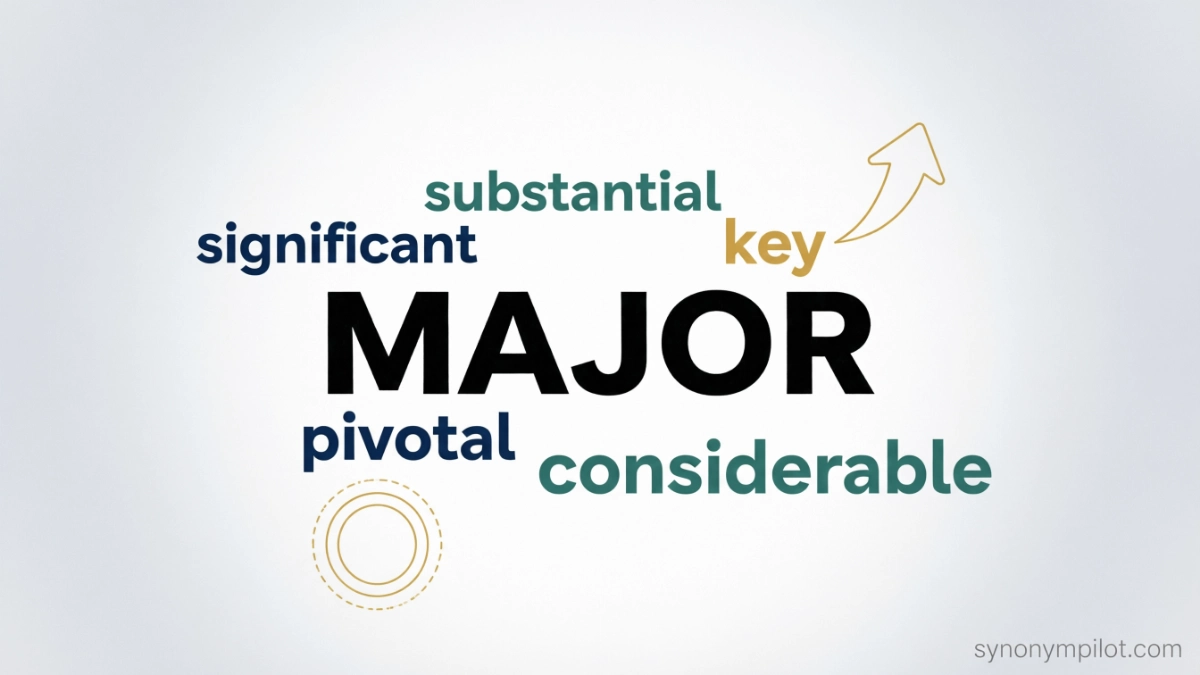
“Major” means large, important, or significant in size, degree, or impact. It can describe events, problems, decisions, or changes that have a strong effect. Words like “significant,” “substantial,” or “key” can replace “major” depending on whether you mean size, importance, or seriousness.
You’re catching up with a friend, and they mention, “We had a major change at work last month half the team got restructured.”
You nod, picturing something big and disruptive. But if you were writing a report about the same event, “major” might feel a little vague.
“We experienced a significant organizational restructuring” sounds more precise and professional, even though it describes the exact same situation.That shift from a general word to a more specific one is exactly what this article will help you make.
What Does “Major” Mean?
“Major” describes something large, important, or significant in size, scale, or impact. It can describe events (“a major storm”), decisions (“a major life choice”), problems (“a major issue”), or changes (“a major shift in policy”). It is one of the most commonly used words in English for expressing that something matters a great deal or is considerably larger than usual.
Meaning, Tone, and Context
At its core, “major” signals that something stands out due to its size, importance, or impact compared to what is typical or expected. The tone of “major” is neutral and works comfortably across nearly every context casual conversation, professional writing, academic discussion, and journalism.
“Major” sounds natural in everyday speech (“that’s a major problem”), professional writing (“the company announced major changes to its leadership structure”), academic contexts (“the study identifies major factors influencing climate change”), and news reporting (“a major earthquake struck the region overnight”).
Because “major” is so broad, it can sometimes feel generic, especially when used repeatedly. Saying “major changes,” “major issues,” and “major decisions” all in the same paragraph can make writing feel repetitive. A more specific synonym “substantial,” “pivotal,” “sweeping,” or “groundbreaking” often communicates the exact type and degree of importance more precisely.
When and How to Use “Major”
Use “major” when you want a simple, clear, and universally understood way to indicate that something is significant in size, importance, or impact.
Here are natural examples across different situations:
- “There was a major accident on the highway this morning.” (casual, descriptive)
- “The company made a major investment in renewable energy.” (professional, business)
- “This represents a major breakthrough in cancer research.” (academic, scientific)
- “Choosing a college major is a big decision for many students.” (specific noun usage academic field of study)
When you want your writing to feel more precise, formal, or varied, a synonym such as “significant,” “substantial,” or “pivotal” often communicates the same idea with a more polished or specific tone.
Another Word for Major
If you need one quick, reliable alternative depending on context:
- For formal or professional writing → significant or substantial
- For academic writing → considerable or substantial
- For describing a turning point → pivotal or decisive
- For describing scale or scope → large scale or sweeping
- For casual conversation → big or huge
There is no single “best” replacement for “major” the right word depends on whether you mean size, importance, urgency, or impact.
When Not to Use This Word
Avoid “major” when you mean “minor” but use it sarcastically or ironically without making that clear. “That’s a major problem” can sound sarcastic if the issue is actually tiny “that’s a huge deal” said sarcastically works the same way, but without context, readers might take “major” literally.
Avoid “major” in academic writing when a more precise word would strengthen your argument. “Major factors” is acceptable, but “the most significant factors” or “the primary factors” can sound more analytical and specific, especially when ranking importance.
Avoid using “major” repeatedly within the same paragraph or document. If every change, issue, and decision is described as “major,” the word loses its impact. Varying with “substantial,” “considerable,” “significant,” or “key” keeps writing fresh and precise.
Words Commonly Confused With Major
Major vs. Significant:
“Significant” often implies that something has a meaningful effect or consequence, sometimes in a more measured or analytical sense. “Major” focuses more on size or scale. “A significant difference” might be measurable but not necessarily huge. “A major difference” implies something large and noticeable.
Major vs. Main:
“Main” describes the most important or central element among several often used for parts of a whole. “Major” describes something large or important on its own, without necessarily comparing it to other elements. “The main reason for the delay was weather” identifies the primary cause. “A major reason for the delay was weather” suggests it was one of several important factors, though possibly not the only or most important one.
Major vs. Critical:
“Critical” implies urgency or a decisive moment often related to risk or danger. “Major” describes size or importance without necessarily implying urgency. “A critical issue” suggests immediate attention is needed. “A major issue” suggests it’s significant, but doesn’t necessarily demand immediate action.
Major vs. Minor:
These are direct opposites. “Major” describes something large, significant, or important. “Minor” describes something small, less important, or less serious. “A major injury” requires significant medical attention. “A minor injury” is something small, like a scrape or bruise.
Best Synonym by Context
| Context | Best Synonym | Why It Fits |
|---|---|---|
| Business / professional | Significant, substantial, considerable | Polished, formal, and precise tone |
| Academic writing | Considerable, substantial, primary | Analytical and measured language |
| Describing change | Sweeping, large-scale, dramatic | Emphasizes scope and impact clearly |
| Describing decisions / events | Pivotal, decisive, defining | Highlights importance and influence on outcomes |
| News / journalism | Significant, large-scale, widespread | Common in reporting and headlines |
| Casual conversation | Big, huge, massive | Natural, simple, and commonly used |
| Academic field (noun usage) | Field of study, specialization, major | Correct academic terminology for education |
Which Synonym Should You Choose?
Ask yourself these quick questions before picking a replacement for “major”:
1. Are you describing size, importance, or impact? “Substantial” and “large scale” describe size. “Significant” and “important” describe meaning or consequence. “Pivotal” and “decisive” describe impact on outcomes.
2. How formal is the context? “Big” and “huge” suit casual conversation. “Substantial,” “considerable,” and “significant” suit professional or academic writing.
3. Are you comparing this to other factors? “Primary” and “main” imply ranking among several factors. “Major” can stand alone without that comparison.
4. Is this about a noun (academic subject) or an adjective (importance/size)? “Major” as a noun refers to a field of study “field of study,” “specialization,” or “concentration” work as related terms. “Major” as an adjective describes size or importance, and the synonyms above apply.
Real Life Examples of “Major” in Sentences
School:
“Choosing a college major can feel overwhelming with so many options available.”
“The history exam covers all the major events of the twentieth century.”
Workplace:
“The company is undergoing a major restructuring this quarter.”
“There was a major miscommunication between the two departments.”
Writing:
“The novel explores several major themes, including identity and belonging.”
“Critics described the film as a major achievement in independent cinema.”
Conversation:
“That was a major win for the team everyone’s still talking about it.”
“I had a major realization after talking to my mentor yesterday.”
50 Synonyms for “Major”
| Synonym | Simple Meaning | Example Sentence |
|---|---|---|
| Significant | Important enough to matter | The policy had a significant impact on employees. |
| Substantial | Large in amount or importance | The company made a substantial investment. |
| Considerable | Worth attention due to size or effect | There was considerable interest in the product. |
| Important | Having great value or influence | This is an important decision for the future. |
| Key | Essential or central | Trust is a key factor in success. |
| Primary | Most important | The primary goal is cost reduction. |
| Main | Most important among several | The main issue was communication. |
| Principal | Chief or most important (formal) | The principal cause was human error. |
| Leading | Most prominent in a field | She is a leading expert in medicine. |
| Dominant | Most powerful or influential | Price is the dominant factor here. |
| Critical | Extremely important | This is a critical step in the process. |
| Pivotal | Crucial to the outcome | The meeting was pivotal for the company. |
| Decisive | Strongly influencing outcome | Her vote was decisive. |
| Defining | Shaping importance or character | That moment was a defining experience. |
| Sweeping | Wide-ranging and significant | Sweeping reforms were introduced. |
| Large-scale | Involving large size or scope | A large-scale project was launched. |
| Widespread | Affecting many areas or people | There was widespread support. |
| Extensive | Large in scope or coverage | The report includes extensive research. |
| Massive | Very large in size or impact | The company faced a massive loss. |
| Huge | Very large (informal) | This is a huge opportunity. |
| Enormous | Extremely large | The change had an enormous effect. |
| Tremendous | Very great in degree or impact | It had a tremendous impact. |
| Vast | Extremely large in amount or area | They manage a vast database. |
| Big | Large or important (informal) | This is a big decision. |
| Serious | Important and requiring attention | They had a serious discussion. |
| Drastic | Extreme and significant | Drastic changes were made. |
| Profound | Deep and very significant | The experience had a profound effect. |
| Far-reaching | Having wide impact | The law has far-reaching consequences. |
| Game-changing | Transformative in effect | The technology was game-changing. |
| Landmark | Highly significant turning point | It was a landmark decision. |
| Groundbreaking | Highly innovative and important | It was groundbreaking research. |
| Watershed | Major turning point | The event was a watershed moment. |
| Notable | Worth attention | There was a notable improvement. |
| Noteworthy | Especially important | His work was noteworthy. |
| Heavyweight | Highly influential (informal) | He is a heavyweight in politics. |
| High-profile | Widely known or important | The case was high-profile. |
| Top-tier | Highest level or rank | She works in a top-tier firm. |
| Core | Central and essential | Honesty is a core value. |
| Fundamental | Basic and essential | Trust is fundamental. |
| Cardinal | Of highest importance (formal) | Honesty is a cardinal rule. |
| Chief | Most important | The chief concern is safety. |
| Central | At the core of something | Education is central to growth. |
| Substantial (repeated emphasis use) | Meaningful and large | They made substantial progress. |
| Big | Important (informal) | This is a big opportunity. |
| Mainstream | Widely accepted or dominant | The idea became mainstream. |
| Headline | Most important or attention-grabbing | It was headline news. |
| Major (literal synonym use note) | Very important or large | It was a major breakthrough. |
Synonym Groups & Usage Differences
Formal
Substantial, considerable, principal, cardinal, profound, pivotal suit academic writing, official reports, and formal correspondence. These words sound precise and avoid the informal feel of “big” or “huge.”
Informal
Big, huge, massive, heavyweight sound natural in everyday conversation and casual writing among friends and colleagues.
Academic
Considerable, substantial, primary, fundamental, profound appear frequently in research writing, especially when discussing factors, findings, or significance.
Professional
Significant, substantial, key, strategic (related), high profile, far reaching sound polished and appropriate for business reports and workplace communication.
Strongest vs. Weaker
“Massive,” “enormous,” and “vast” describe extremely large size or impact stronger than “major.” “Notable” and “noteworthy” describe something worth attention but not necessarily huge weaker than “major.”
Modern vs. Old Fashioned
“Cardinal” can sound slightly old fashioned or formal in everyday writing, though it remains common in phrases like “cardinal rule” or “cardinal sin.” “Game changing” and “groundbreaking” feel modern and frequently appear in business and tech writing today.
Noun Usage (Academic Field)
“Field of study,” “specialization,” “concentration,” and “discipline” all relate to “major” as a noun describing someone’s primary subject of study at university. These are not interchangeable with the adjective meanings of “major” (important, large).
Antonyms of “Major”
| Antonym | Meaning | Example Sentence |
|---|---|---|
| Minor | Small in importance or seriousness | It was only a minor issue that was quickly resolved. |
| Insignificant | Too small or unimportant to matter | The difference was insignificant. |
| Trivial | Of little value or importance | They argued over a trivial detail. |
| Negligible | So small it can be ignored | The effect was negligible in the final results. |
| Small-scale | Limited in size or scope | It started as a small-scale experiment. |
| Secondary | Less important than something else | Cost was a secondary concern. |
| Slight | Very small in degree or amount | There was a slight improvement in performance. |
| Marginal | Barely important or noticeable | The change had a marginal effect. |
| Unimportant | Not worth attention | The issue is unimportant in this context. |
| Limited | Restricted in size or scope | The impact was limited to one region. |
| Minor-scale (less common usage) | Small in overall scale | The project remained at a minor-scale level. |
| Peripheral | Not central or essential | It was a peripheral issue in the discussion. |
Comparison:
Major vs. Related Words
These words often overlap with “major,” but each carries a distinct emphasis on scale, importance, or impact.
Major vs. Significant
“Significant” often implies a meaningful or measurable effect, sometimes in a more analytical or statistical sense. “Major” focuses more on overall size or scale. “A significant correlation” might be statistically meaningful but small in everyday terms. “A major change” implies something large and noticeable to most people.
Major vs. Main
“Main” identifies the most important element among several options or factors it’s comparative. “Major” describes something large or important on its own, without necessarily ranking it against others. “The main issue” suggests there’s one issue more important than the rest. “A major issue” suggests it’s significant, though there could be other major issues too.
Major vs. Critical
“Critical” implies urgency, risk, or a decisive moment often something that could fail or go wrong. “Major” describes size or importance without that urgency. “A critical decision” suggests high stakes and possibly immediate consequences. “A major decision” suggests significance, but not necessarily danger or urgency.
Major vs. Substantial
“Substantial” often describes quantity, amount, or degree particularly in financial, academic, or measurable contexts. “Major” is broader and can describe events, changes, or decisions without necessarily involving measurable quantities. “A substantial increase in revenue” focuses on the measurable amount. “A major increase in revenue” conveys the same idea with slightly more general emphasis.
Major vs. Minor (as Academic Terms)
As nouns related to education, “major” refers to a student’s primary field of study, while “minor” refers to a secondary field studied alongside the major, usually requiring fewer courses. “She majored in biology and minored in chemistry” shows how these terms work together in academic contexts completely separate from their adjective meanings (important vs. unimportant).
Common Phrases and Expressions
“Major league” operating at a high level of skill, importance, or competition, often used metaphorically.
Example: “After years of small projects, she’s finally working with major league clients.”
“Make a major splash” to attract a lot of attention or have a significant impact.
Example: “The startup made a major splash at the tech conference with its new product.”
“A major player” someone or something with significant influence in a particular field.
Example: “The company has become a major player in the renewable energy market.”
“Major overhaul” a significant and thorough change or renovation.
Example: “The website is getting a major overhaul to improve user experience.”
“In a major way” to a great extent or degree.
Example: “The new policy affected small businesses in a major way.”
“Major in” (academic) to study a particular subject as your primary focus at university.
Example: “She decided to major in computer science after taking an introductory coding course.”
Common Mistakes to Avoid
Using “major” repeatedly in the same document:
Describing every issue, change, and decision as “major” makes writing feel repetitive and reduces impact. Rotating with “significant,” “substantial,” “pivotal,” and “considerable” adds variety and precision.
Confusing “major” and “main” in comparative contexts:
“The main reason” identifies the single most important factor. “A major reason” suggests it’s one of several important factors. Using “main” when there are multiple equally important factors can sound inaccurate.
Using “major” for the academic noun without context:
“She has a major in psychology” is correct. “She majors psychology” is incorrect the verb form requires “in”: “she majors in psychology.”
Mixing up “major” and “critical” in urgent situations:
“A major problem” suggests significance, but doesn’t necessarily mean immediate danger. “A critical problem” implies urgency and risk. Using “major” when something requires immediate action can underplay the seriousness of the situation.
Overusing “huge” or “massive” in formal writing:
While common in casual speech, “huge” and “massive” can sound informal in academic or professional contexts. “Substantial,” “considerable,” or “significant” often communicate the same scale with a more polished tone.
FAQs
What is a more formal word for “major” in academic writing?
A: “Substantial,” “considerable,” and “significant” are all common formal alternatives. “Considerable evidence supports this theory” sounds more analytical than “major evidence supports this theory.”
What is the difference between “major” and “main”?
A: “Main” identifies the single most important element among several it’s comparative. “Major” describes something large or important without necessarily ranking it first among other factors. Can “major” be used as a noun?
A: Yes, especially in academic contexts. “Major” can refer to a student’s primary field of study at university “her major is biology.” Related terms include “specialization,” “concentration,” and “field of study.”
what is a stronger word than “major” for describing a huge change?
A: “Sweeping,” “drastic,” “massive,” and “far reaching” all describe larger or more dramatic changes than “major” typically implies. “Sweeping reforms” suggests changes across an entire system, not just one part.
Is “major” the same as “critical” in importance?
A: Not quite. “Critical” often implies urgency or risk something that could fail without immediate attention. “Major” describes size or significance without necessarily implying urgency. Something can be major without being critical, and critical without necessarily being major in scale.
Conclusion
“Major” is a flexible, widely used word for describing size, importance, and impact but its flexibility is also why it sometimes feels generic, especially when repeated throughout a piece of writing.
Once you start noticing whether you mean size, importance, urgency, or a turning point, choosing a more specific synonym becomes much easier.
This week, try noticing how often “major” appears in your writing or conversation. If you’re describing a turning point, try “pivotal” or “decisive.” If you mean something large in scale, try “substantial” or “sweeping.”
If you’re talking about your studies, remember that “major” works as a noun too, alongside related words like “specialization” and “concentration.” With a little practice, these alternatives will start coming naturally, making your English sound more precise and varied.

Hi, I’m George Philip—an English language enthusiast who enjoys uncovering the nuances of words. I write about synonyms, vocabulary, and everyday language tips so readers can improve their communication and express themselves effectively. Learning new words should be fun, practical, and inspiring! synonympilot.com