QUICK ANSWER
“Crucial” means extremely important something that has a huge impact on the outcome of a situation. It describes something you simply cannot ignore or skip. Teachers, doctors, managers, and writers all use it to stress that something is absolutely necessary for success.
You’re writing an email to your manager about a project deadline, and you type: “This step is crucial to our success.” It feels right. But then you pause could you say “vital” instead? Or “essential”? Or maybe something stronger?
That’s exactly where most English learners get stuck. “Crucial” is one of those words that sounds confident and serious, but once you start looking for alternatives, the choices can feel overwhelming.
In this guide, you’ll learn what “crucial” really means, when to use it, which synonyms work best in different situations, and how to avoid the most common mistakes. By the end, your vocabulary will feel noticeably more natural and flexible.
MEANING, TONE & CONTEXT
At its core, “crucial” means something is of great importance so important that the result of a situation depends on it. It often suggests that without this particular thing, something will go wrong or fail entirely.
The tone is serious and direct. It sits comfortably in both formal and professional writing as well as everyday conversation. You’ll hear it in news reports, business emails, academic essays, and casual discussions between friends.
What makes “crucial” feel strong is that it implies consequence. It’s not just “important” it suggests that something is a turning point or a deciding factor. When a doctor says a test is crucial, or a coach says a practice session is crucial before the championship, they mean that skipping it could change everything.
It works most naturally before a noun (“a crucial decision”) or before an infinitive phrase (“crucial to understand”). It rarely sounds right in very informal, slang heavy conversations, where words like “key” or “big deal” feel more natural.
WHEN & HOW TO USE “CRUCIAL”
Use “crucial” when you want to emphasize that something matters a great deal and carries real consequences. It’s especially powerful in professional, academic, and serious conversational settings.
Here are some situations where it fits perfectly:
In a business context: “Clear communication is crucial during a merger.”
In academic writing: “The researcher identified three crucial variables in the experiment.”
In everyday conversation: “It’s crucial that you read the instructions before you start.”
In health or safety contexts: “Wearing a helmet is crucial when riding a motorcycle.”
Notice that in each case, the word signals high stakes. If you’re talking about something minor or trivial, “crucial” will feel too heavy. Reserve it for situations where the outcome genuinely matters.
ANOTHER WORD FOR CRUCIAL
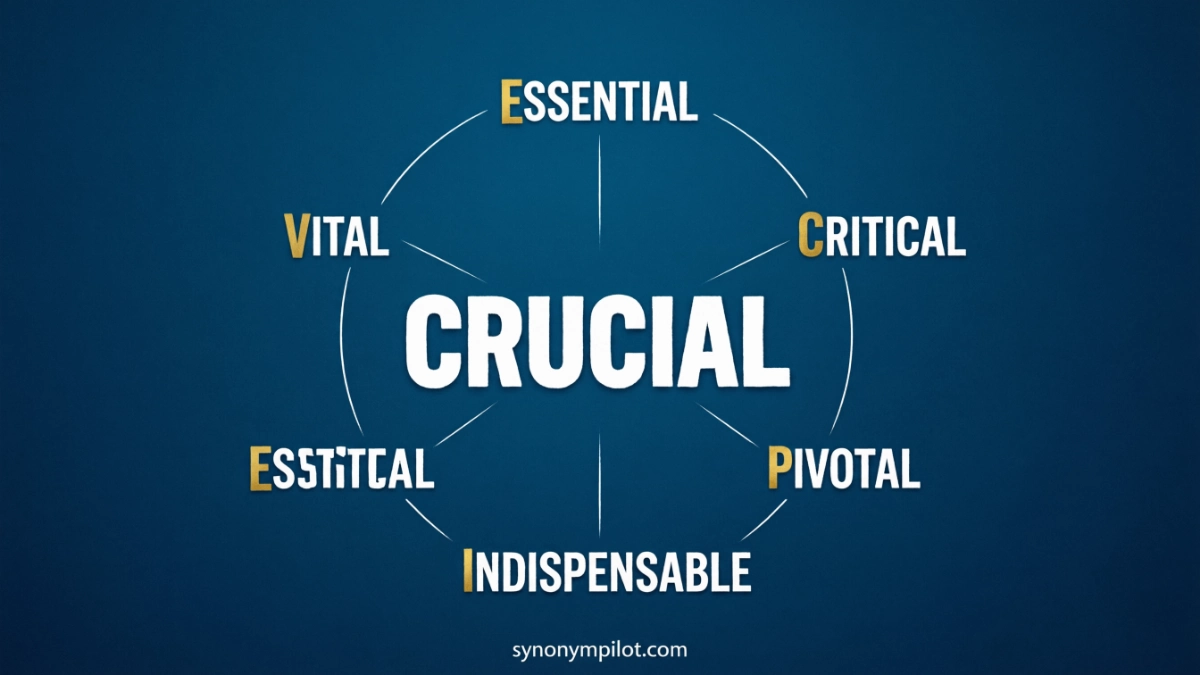
The most commonly used synonyms for “crucial” include: essential, vital, critical, key, important, significant, fundamental, necessary, pivotal, and decisive. Each carries a slightly different shade of meaning, so the right choice depends on your context and tone.
WHEN NOT TO USE THIS WORD
Avoid using “crucial” for everyday, low stakes situations. Saying “It’s crucial that you try this new flavor of ice cream” sounds dramatic and unnatural. Similarly, don’t overuse it in a single piece of writing if every sentence has “crucial,” the word loses its power.
Also avoid “crucial” in very casual or humorous conversations where it may sound overly stiff. In those moments, “important,” “big,” or “key” feel more human and relaxed.
WORDS COMMONLY CONFUSED WITH CRUCIAL
Critical vs. Crucial: “Critical” can mean extremely important, but it also means “involving criticism” or “at a crisis point.” Use “crucial” when you want to avoid that double meaning.
Essential vs. Crucial: “Essential” focuses on something being a necessary part of a whole. “Crucial” focuses on high stakes importance. A vitamin can be essential to health, but a decision can be crucial to a company’s future.
Vital vs. Crucial: “Vital” carries a sense of life and energy it often implies something is life giving or deeply necessary. “Crucial” is more about a decisive or turning point moment.
Best Synonym by Context
| Context | Best Synonym | Why It Works |
|---|---|---|
| Business / Professional | Critical | Signals high stakes, urgency, and decision impact |
| Academic Writing | Fundamental | Suggests a base-level concept or necessity |
| Medical / Health | Vital | Implies life-dependent importance |
| Conversation / Casual | Key | Short, natural, and commonly used |
| Emotional / Personal | Essential | Conveys deep personal importance |
| Politics / News | Pivotal | Indicates a turning point or major shift |
| Teaching / Education | Important | Clear, simple, and widely understood |
| Leadership / Strategy | Decisive | Shows influence over final outcomes |
WHICH SYNONYM SHOULD YOU CHOOSE?
If you’re writing a formal report or academic paper, go with “critical,” “fundamental,” or “pivotal.” These words carry academic weight.
If you’re speaking in a meeting or writing a professional email, “key,” “essential,” or “critical” all work well and sound natural.
If you’re writing creatively or telling a story, “vital” or “decisive” can add drama and emotional depth.
If you’re having a casual conversation, simply say “important,” “big,” or “key” shorter words often land better in everyday speech.
The best synonym is always the one that matches your audience, your tone, and the weight of what you’re describing.
REAL LIFE EXAMPLES OF “CRUCIAL” IN SENTENCES
School: “Understanding the main argument is crucial before you start writing your essay.”
Workplace: “Staying in contact with the client during this phase is crucial for the project’s success.”
Writing: “The author made a crucial point in the third chapter that changed the direction of the entire book.”
Conversation: “It’s crucial that we leave by 7 a.m. if we want to catch the train.”
50 Synonyms for “Crucial”
| Synonym | Simple Meaning | Example Sentence |
|---|---|---|
| Essential | Absolutely necessary | Sleep is essential for good health. |
| Vital | Extremely important, life-related | Hydration is vital for health. |
| Critical | Extremely important; decisive | The first hour is critical in emergencies. |
| Key | Most important factor | Trust is the key to success. |
| Important | Of great significance | It is important to plan ahead. |
| Significant | Noticeably important | She made a significant contribution. |
| Fundamental | Basic and essential | Respect is fundamental in society. |
| Necessary | Required for a purpose | A visa is necessary for travel. |
| Pivotal | Acting as a turning point | The meeting was pivotal for the deal. |
| Decisive | Determining the outcome | His vote was decisive. |
| Indispensable | Cannot be replaced | She is indispensable to the team. |
| Imperative | Urgently required | It is imperative we act now. |
| Core | Central and essential | Honesty is a core value. |
| Central | At the heart of something | Communication is central to success. |
| Primary | First in importance | Safety is the primary concern. |
| Major | Very important or large impact | This is a major development. |
| Principal | Main or chief | The principal reason was cost. |
| Cardinal | Of highest importance (formal) | Kindness is a cardinal virtue. |
| Paramount | Above all else in importance | Safety is paramount. |
| Pressing | Requires immediate attention | There is a pressing need for reform. |
| Urgent | Needs immediate action | This is an urgent matter. |
| Lifeline | Something essential for survival | Aid was a lifeline for refugees. |
| Determining | Deciding the outcome | Effort is a determining factor. |
| Defining | Shaping character or outcome | This was a defining moment. |
| High-stakes | Involving serious consequences | It was a high-stakes negotiation. |
| Momentous | Extremely important event | The treaty was momentous. |
| Serious | Important and requiring attention | This is a serious issue. |
| Weighty | Very important and serious | A weighty decision was made. |
| Strategic | Important for long-term planning | It was a strategic move. |
| Priority | Something most important | Safety is our top priority. |
| Worthwhile | Worth time and effort | The training was worthwhile. |
| Compulsory | Required by authority | Attendance is compulsory. |
| Required | Officially needed | A signature is required. |
| Mandatory | Not optional | Training is mandatory. |
| Needed | Simply required | More funding is needed. |
| Integral | Essential part of whole | She is integral to the team. |
| Non-negotiable | Cannot be changed | Punctuality is non-negotiable. |
| All-important | Extremely important | Timing is all-important. |
| Overriding | More important than others | Safety is the overriding concern. |
| Compelling | Strongly important/reasoned | There is a compelling reason to act. |
| Acute | Extremely urgent | There is an acute shortage. |
| Life-or-death | Survival dependent | It was a life-or-death situation. |
| Mission-critical | Essential for success | Security is mission-critical. |
| Make-or-break | Determines success or failure | It was a make-or-break moment. |
| Consequential | Having major effects | The decision was highly consequential. |
| Far-reaching | Wide and lasting impact | It has far-reaching consequences. |
| Irreplaceable | Cannot be replaced | She is irreplaceable on the team. |
| Must-have | Absolutely required | A laptop is a must-have tool. |
| Landmark | Highly significant event | It was a landmark ruling. |
| Pivotal (repeat emphasis) | Turning point | The deal was pivotal for growth. |
SYNONYM GROUPS & USAGE DIFFERENCES
Formal Synonyms: critical, indispensable, imperative, paramount, cardinal
These words work best in academic writing, legal documents, formal speeches, and professional reports. They carry authority and are expected in serious written communication.
Professional / Business Synonyms: key, strategic, priority, mission critical, non negotiable
These feel natural in emails, presentations, boardrooms, and business plans. They’re direct, action oriented, and clear.
Conversational Synonyms: important, needed, big, must have, pressing
These feel relaxed and human. You’d use them naturally with friends, family, or in casual team chats.
Academic Synonyms: fundamental, integral, central, determining, significant
These suit research papers, essays, and textbook language. They explain importance in a structured, analytical way.
Strongest Synonyms: indispensable, paramount, imperative, life or death, make or break
Use these when you want maximum impact. They signal urgency, high stakes, or irreversibility. Overusing them weakens their effect.
Weaker Alternatives: important, needed, worthwhile, serious
These are safer and more neutral. They’re useful when “crucial” would feel too dramatic for the situation.
Emotional Synonyms: vital, life or death, irreplaceable, lifeline
These add warmth and human weight. You’d use them in personal stories, motivational writing, or when discussing something deeply meaningful.
Neutral / Objective Synonyms: necessary, required, mandatory, compulsory
These are factual and unemotional. They work well in instructions, guidelines, and rule based writing.
Modern Business Slang: mission critical, make or break, must have, high stakes
These are popular in startup culture, tech writing, and corporate communication. They sound current and energetic.
Antonyms of “Crucial”
| Antonym | Meaning | Example Sentence |
|---|---|---|
| Unnecessary | Not needed | This step is unnecessary and can be skipped. |
| Unimportant | Of little significance | The color is unimportant. |
| Trivial | Too minor to matter | He focused on trivial details instead of the main task. |
| Insignificant | Too small to matter | The delay was insignificant overall. |
| Optional | Not required; by choice | Attendance is optional. |
| Negligible | So small it can be ignored | The cost difference is negligible. |
| Minor | Small in importance or effect | It was only a minor issue. |
| Incidental | Secondary or not central | The benefit was incidental. |
| Peripheral | Not central; on the edge | The issue is peripheral to the discussion. |
| Dispensable | Can be removed or replaced | No employee should feel dispensable. |
| Non-essential | Not absolutely required | The feature is non-essential. |
| Extra | Additional, not required | The service includes extra features. |
| Secondary | Less important than main point | Cost was a secondary concern. |
| Superfluous | Excess or unnecessary | The report included superfluous details. |
| Unneeded | Not required | The update is unneeded. |
COMPARISON SECTION
Crucial vs. Critical:
Both signal high importance, but “critical” can also mean evaluating or judging something (“critical thinking,” “critical review”). Use “crucial” when you want to avoid that second meaning. “Critical” also sounds slightly more clinical or technical.
Crucial vs. Essential:
“Essential” often implies something is a necessary building block like essential nutrients or essential skills. “Crucial” implies a decisive moment or turning point. You can say vitamins are essential, but a team meeting before a product launch is crucial.
Crucial vs. Vital:
“Vital” comes from the Latin word for life. It carries a biological or life sustaining quality. “Crucial” is more about decision making and outcomes. A heartbeat is vital; a signature on a contract is crucial.
Crucial vs. Pivotal:
“Pivotal” specifically suggests a turning point a moment that shifts everything in a new direction. “Crucial” is broader. A pivotal moment is always crucial, but not every crucial thing is a pivotal turning point.
Crucial vs. Important:
“Important” is general and mild. “Crucial” is stronger and more urgent. Use “important” for everyday significance; use “crucial” when the stakes are genuinely high.
COMMON PHRASES & EXPRESSIONS
“Crucial moment” A point in time where the outcome will be decided.
Example: “The goalkeeper saved the ball at a crucial moment in the match.”
“Crucial role” A central and necessary function someone or something performs.
Example: “Teachers play a crucial role in shaping the future generation.”
“Crucial factor” A key element that significantly influences a result.
Example: “Diet is a crucial factor in long term health.”
“Crucial step” An action that must happen for progress to continue.
Example: “Submitting the application on time is a crucial step in the process.”
“Crucial decision” A choice with serious, lasting consequences.
Example: “Choosing the right business partner is a crucial decision.”
“Play a crucial part” To be an important contributor to something.
Example: “Volunteers play a crucial part in keeping the event running.”
“At a crucial stage” At a point where careful action matters most.
Example: “We are at a crucial stage in the negotiations.”
COMMON MISTAKES TO AVOID
Overusing “crucial”: If you write “crucial” five times in one paragraph, it loses its strength. Vary your word choice using synonyms like “key,” “vital,” or “essential.”
Confusing “crucial” with “critical”: Remember, “critical” has multiple meanings. In medical contexts, “critical condition” means someone is near death. Use carefully so your meaning stays clear.
Using “crucial” for small things: Reserve “crucial” for genuinely high stakes situations. Saying a color choice is “crucial” for a birthday card sounds exaggerated and unnatural.
Mixing formal and casual tones: If you’re writing a casual message, swap “crucial” for “important” or “key.” Using formal vocabulary in informal settings can feel stiff or robotic.
Forgetting natural collocations: “Crucial” pairs naturally with words like moment, role, factor, step, decision, and point. Avoid unusual combinations like “crucial food” or “crucial weather” these don’t sound natural.
FAQs
What is the simplest synonym for “crucial” in everyday conversation?
A: “Important” is the most natural and versatile choice for everyday use. It works in any situation without sounding too formal or too casual.
Is “crucial” stronger than “important”?
A: Yes. “Crucial” carries a higher level of urgency and suggests that consequences are at stake. “Important” is more general and mild. Think of it this way everything crucial is important, but not everything important is crucial.
Can I use “crucial” and “critical” interchangeably?
A: Often yes, but not always. “Critical” can also mean “expressing judgment” or “at a point of crisis,” so in some contexts it can confuse the reader. When you only want to say something is extremely important, “crucial” is cleaner and safer.
Is “crucial” formal or informal?
A: It sits comfortably in both. It’s common in business emails, academic writing, news articles, and everyday speech. However, in very casual or humorous conversations, shorter words like “key” or “big” tend to feel more natural.
What is the noun form of “crucial”?
A: The closest noun form is “cruciality,” but it’s rarely used. In most cases, writers restructure the sentence instead for example, saying “the importance of this decision” rather than “the cruciality of this decision.” The adjective “crucial” is far more common than its noun form.
CONCLUSION
Building a strong vocabulary isn’t about memorizing word lists it’s about understanding how words actually work in real life. “Crucial” is a powerful word, and now that you know its closest synonyms, you can choose the exact right word for every situation, If you’re writing an essay, sending a professional email, or having a conversation.
Try using one new synonym this week. Maybe replace “important” with “pivotal” in your next email, or use “fundamental” in an essay where you would normally write “crucial.” Small practice habits like these make a real difference over time.
The more you play with words in context, the more confident and natural your English will sound and that, genuinely, is the most crucial step of all.

Hi, I’m J.D. Salinger—a language lover who enjoys uncovering the nuances of words. I write about synonyms, meanings, and vocabulary tips to help readers express themselves more clearly and confidently. My goal is to make learning new words fun, simple, and practical. synonympilot.com