Quick Answer
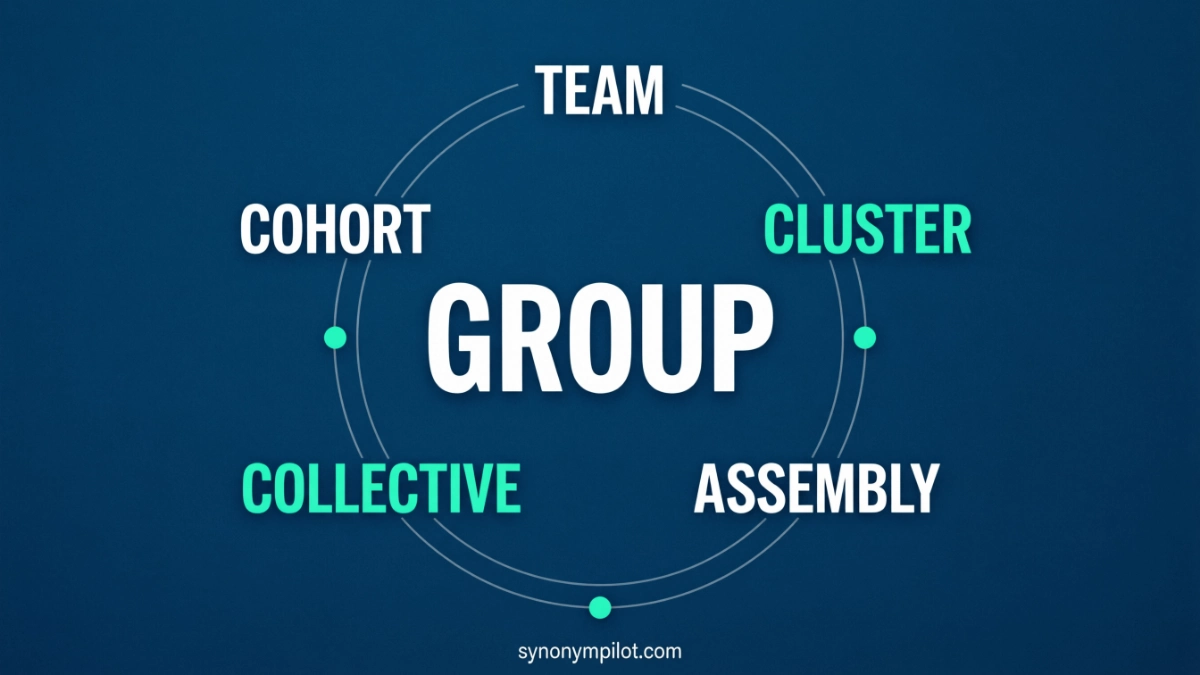
A “group” is a collection of people, animals, or things that are connected, gathered, or categorized together. Depending on your situation, you can replace it with words like team, cluster, assembly, crowd, or collective. Choosing the right synonym instantly makes your writing sharper and more natural.
Picture this: you’re writing an email to a client and you’ve already used the word “group” four times in two paragraphs. Or maybe you’re describing a panel of scientists, a flock of birds, or a crowd at a football stadium, and “group” just feels too flat and generic.
That frustration is completely normal, and it’s exactly why expanding your vocabulary around this one common word pays off so quickly.
“Group” is one of those everyday words that works in almost any situation, which is both its strength and its limitation. Because it’s so broad, it often says far less than it could.
English gives you dozens of stronger, more precise alternatives, and using the right one in the right context makes a real difference in how clear, professional, and natural your communication sounds.
Meaning, Tone, and Context
At its core, “group” simply means a number of people, things, or animals that are together or share something in common. It is completely neutral in tone, which means it fits formal writing, casual speech, academic essays, and professional emails equally well.
However, that same neutrality is also what makes it feel vague at times. When a more specific word exists, using it shows stronger command of English. For instance, “the committee reviewed the plan” sounds more authoritative than “the group reviewed the plan.” Similarly, “a cluster of stars” paints a clearer picture than “a group of stars.”
The key is understanding that tone, context, and the type of people or things involved all determine which synonym fits best.
When and How to Use “Group”
“Group” works perfectly when you need a general, widely understood term and when no specific synonym clearly applies.
Use it in everyday conversation: “A group of friends went hiking last weekend.”
Use it in instructions or directions: “Please divide into groups of three.”
Use it in informal writing when broad clarity matters more than precision.
On the other hand, whenever you know more about the nature of the gathering, organization, or relationship involved, a stronger word almost always exists and should be used instead.
Another Word for Group
Some of the most natural and widely used synonyms for “group” include team, crowd, cluster, collection, assembly, gathering, band, crew, squad, set, panel, cohort, batch, league, coalition, ensemble, mob, faction, community, and collective. Each carries a slightly different shade of meaning depending on if people, objects, or animals are involved and how formally you are writing.
When Not to Use “Group”
Avoid “group” when a more specific and accurate word clearly fits your context. In professional writing, defaulting to “group” can feel imprecise or even lazy. In academic writing, more exact vocabulary signals expertise and credibility. In emotional or literary writing, “group” tends to feel cold and flat compared to warmer alternatives like “gathering” or “community.”
Additionally, avoid “group” when your audience expects specialized vocabulary. A doctor writing about research participants would say “cohort,” not “group.” A music journalist would say “ensemble,” not “group.”
Words Commonly Confused With “Group”
Several words are frequently mixed up with “group,” even though their meanings differ in important ways.
“Crowd” refers specifically to a large and typically unorganized number of people in one place. You would not naturally say “a crowd of experts” unless you were being humorous or ironic.
“Team” implies shared purpose, coordination, and active cooperation. Not every group qualifies as a team just because its members are together.
“Cluster” suggests physical closeness or statistical grouping and works best for objects, data points, or natural phenomena rather than people in professional settings.
“Class” can mean a group of students or a category of things sharing common traits, but in formal writing it also carries social and academic meanings that “group” does not.
Best Synonym by Context for “Group”
| Context | Best Synonym | Why It Fits |
|---|---|---|
| Workplace colleagues | Team / Cohort | Implies shared purpose and structure |
| Academic research | Cohort / Sample / Panel | Precise and appropriately formal |
| Animals | Herd / Pack / Flock | Species-specific and accurate |
| Music or performance | Ensemble / Troupe | Standard terms in the industry |
| Politics or activism | Coalition / Faction | Implies shared ideology or opposition |
| Informal gathering | Bunch / Crew / Gang | Casual, warm, and conversational |
| Data or objects | Cluster / Batch / Set | Neutral and technically appropriate |
| Religion or culture | Congregation / Community | Carries belonging and shared identity |
Which Synonym Should You Choose?
Start by asking yourself three quick questions: What kind of group is it? Are they people, animals, or things? And how formal is the context you are writing in?
If the group is organized people working toward a shared goal, choose team, squad, unit, or corps. If people share beliefs or identity, community, congregation, or movement fits better. If the gathering is loose or unplanned, crowd, bunch, or cluster works well. For academic or professional writing, cohort, panel, assembly, or collective signals precision and expertise. For fiction or narrative writing, band, troupe, or gathering adds texture and atmosphere.
Real Life Examples of “Group” in Sentences
School
“The teacher divided the class into clusters of three for the lab experiment.”
“An assembly of students filled the auditorium for the opening ceremony.”
Workplace
“The panel of reviewers evaluated each proposal with great care.”
“Our cohort of new hires began their orientation training on Monday.”
Writing
“A faction within the council quietly opposed the proposed resolution.”
“The ensemble delivered a breathtaking performance at the gala.”
Conversation
“The whole crew is meeting at the café right after work.”
“There was an enormous crowd gathered outside the stadium last night.”
Antonyms of “Group”
| Antonym | Simple Meaning | Example Sentence |
|---|---|---|
| Individual | A single person rather than a group | Each individual is responsible for completing the assignment. |
| Person | One human being | One person cannot manage the entire event alone. |
| Singleton | A single item or entity | The data point appeared as a singleton rather than part of a cluster. |
| Lone Wolf | Someone who prefers to work alone | He is a lone wolf who rarely joins team projects. |
| Outsider | Someone not belonging to a group | As an outsider, she found it difficult to understand the traditions. |
| Isolation | The state of being separated from others | Long periods of isolation can affect mental well-being. |
| Separation | The condition of being apart | The separation of the departments reduced collaboration. |
| Division | A split into parts rather than a united group | The issue caused division within the organization. |
| Fragment | A broken-off piece of a larger whole | The movement split into several fragments over time. |
| Disunity | Lack of unity or togetherness | Disunity among the members weakened the campaign. |
Synonym Groups and Usage Differences
Formal Synonyms
Words like assembly, committee, council, consortium, and delegation suit formal writing, official reports, academic papers, and professional correspondence. They signal structure, authority, and clear organizational purpose. Use these when register and precision genuinely matter to your audience.
Informal and Conversational Synonyms
Bunch, crew, gang, posse, and pack feel casual, friendly, and natural in everyday speech. They work well on social media, in personal emails, and in informal storytelling. However, these words would feel jarring and unprofessional in a boardroom presentation or academic article.
Academic and Technical Synonyms
Cohort, sample, cluster, category, and set carry precise meanings within research, statistics, and data science. Academics and scientists use these terms because they signal methodological accuracy. “Cohort” in particular has a very specific meaning in medical and social science research that goes well beyond casual use.
Professional and Workplace Synonyms
Team, panel, unit, division, corps, and committee are standard vocabulary in business and organizational communication. They imply clear roles, shared responsibility, and structured collaboration. Professionals in any field expect these words in formal workplace writing and meetings.
Synonyms Specific to Animals
English has highly specific collective nouns for animal groups: a flock of birds, a pack of wolves, a herd of cattle, a swarm of bees, a pride of lions, and a school of fish. Using the correct term shows strong vocabulary awareness and is especially important in academic writing, journalism, and nature content.
Stronger vs. Weaker Options
“Mob” and “swarm” carry intensity and often negative connotation. “Community” and “circle” feel warm and inclusive. “Faction” implies internal conflict or division. Therefore, always choose based on the emotional charge and meaning you want your writing to carry.
Modern vs. Old Fashioned
Words like “band” and “sect” carry an older, more literary feeling. Meanwhile, “network,” “collective,” and “cohort” sound contemporary and appear frequently in current professional and academic writing.
Antonyms of “Group”
| Antonym | Simple Meaning | Example Sentence |
|---|---|---|
| Individual | A single person or entity | Each individual submitted a separate application. |
| Lone | One person or thing, without others | A lone figure stood at the edge of the cliff. |
| Solitary | Alone and without company | She strongly preferred solitary work to group tasks. |
| Singleton | A single isolated item or entity | The algorithm filtered out all the singletons. |
| Loner | A person who avoids groups | He was known as a loner who rarely joined team activities. |
Comparison Section
Group vs. Team
Both words describe people together, but “team” specifically implies coordination and shared goals. A group of strangers waiting at a bus stop is not a team. Use “team” only when people are actively working together toward a common purpose.
Group vs. Crowd
A crowd is typically large, disorganized, and defined by physical presence in one place. “Group” can be small and organized. Naturally, you would say “a crowd cheered” but “a group of advisors met to discuss the issue.”
Group vs. Cluster
“Cluster” focuses on physical closeness or statistical grouping and works best with objects, data, or natural phenomena. “A cluster of galaxies” sounds perfectly natural, while “a cluster of managers” sounds slightly awkward in most professional contexts.
Group vs. Community
“Community” carries a deep sense of shared identity, belonging, and connection that “group” simply does not. A community has culture, history, and emotional bonds. A group merely has proximity or function in common.
Group vs. Collective
“Collective” emphasizes shared ownership, equal participation, and joint action. It carries political and ideological undertones that “group” lacks entirely. Artists, cooperatives, and activist organizations specifically prefer “collective” to stress equality and shared purpose.
Common Phrases and Expressions
“In groups” means doing something as part of a group rather than individually.
Example: “Students completed the research assignment in groups of four.”
“Group effort” describes something achieved through collaboration rather than individual work.
Example: “Winning the regional championship was a genuine group effort.”
“Peer group” refers to people of similar age, background, or social status.
Example: “Adolescents are heavily influenced by the behavior of their peer group.”
“Focus group” describes a selected group brought together specifically to provide feedback or opinions.
Example: “The marketing team ran a focus group before launching the new product.”
“Support group” means people who share a common challenge and meet regularly to help one another.
Example: “She found real comfort and practical advice through her online support group.”
“Interest group” describes people organized around a shared political, social, or professional concern.
Example: “Several interest groups actively lobbied against the proposed environmental legislation.”
Common Mistakes to Avoid
Do not use “crowd” for small or organized gatherings. A crowd implies size and disorder, so “a crowd of three colleagues” sounds unnatural and slightly comic.
Do not treat “team” and “group” as fully interchangeable. Not every group shares goals or cooperates actively, so calling every collection of people a “team” can feel forced and inaccurate.
Be cautious with “gang.” In American English, it frequently carries criminal connotation. In informal British English it is perfectly friendly and neutral, but context and audience matter significantly.
Avoid using “mob” unless you genuinely want to suggest chaos, aggression, or lack of control. It is a strongly loaded word that changes the emotional tone of a sentence immediately.
Do not overuse “collective” in neutral contexts. Its political and ideological undertone can feel out of place in straightforward professional or academic writing where no shared ownership is implied.
FAQs
What is the most common synonym for “group”?
“Team” is probably the most frequently used alternative in everyday English, especially in professional and educational settings, although “crowd,” “bunch,” and “cluster” are also very common depending on the situation.
What is a formal word for “group” in academic writing?
“Cohort” and “sample” are the most widely accepted choices in research and academic writing, while “assembly,” “collective,” and “consortium” work well in formal professional or institutional contexts.
What is the difference between “group” and “team”?
A group is simply a number of people or things together, while a team actively shares a specific goal and works cooperatively to achieve it, meaning every team is a group but not every group qualifies as a team.
Can I use “bunch” in professional writing?
“Bunch” is informal and conversational, so it generally does not suit professional reports, academic papers, or formal business emails, and you should choose words like “team,” “panel,” or “cohort” in those contexts instead.
What word describes a group of animals?
English uses specific collective nouns for animal groups, including “flock” for birds, “pack” for wolves, “herd” for cattle, “pride” for lions, and “school” for fish, and using the correct term demonstrates strong and accurate vocabulary knowledge.
Conclusion
The word “group” is a reliable and safe choice, but it is really just the starting point. English offers a rich and varied set of alternatives that allow you to say exactly what you mean with greater clarity, precision, and confidence.
If you are writing a formal report, crafting a short story, sending a professional email, or simply talking with friends, choosing the right synonym makes your language feel intentional and alive.
Start practicing with small, deliberate swaps. Next time you write “group,” pause and ask if “team,” “cluster,” “assembly,” or “cohort” might communicate your meaning more accurately. Over time, these choices will come naturally and quickly. Vocabulary growth is not about memorizing long lists.
It is about using words in real situations until they become second nature. So take these synonyms out of this article and put them to work in your writing today.

Hi, I’m Theo John, a passionate word explorer who loves diving into the beauty of the English language. I write about synonyms, word meanings, and practical vocabulary tips to help readers communicate with confidence. synonympilot.com