Quick Answer:
“Appreciate” means to recognize the value of something, to be grateful for it, or to understand it fully. It can express thanks, recognition of quality, or deep understanding.
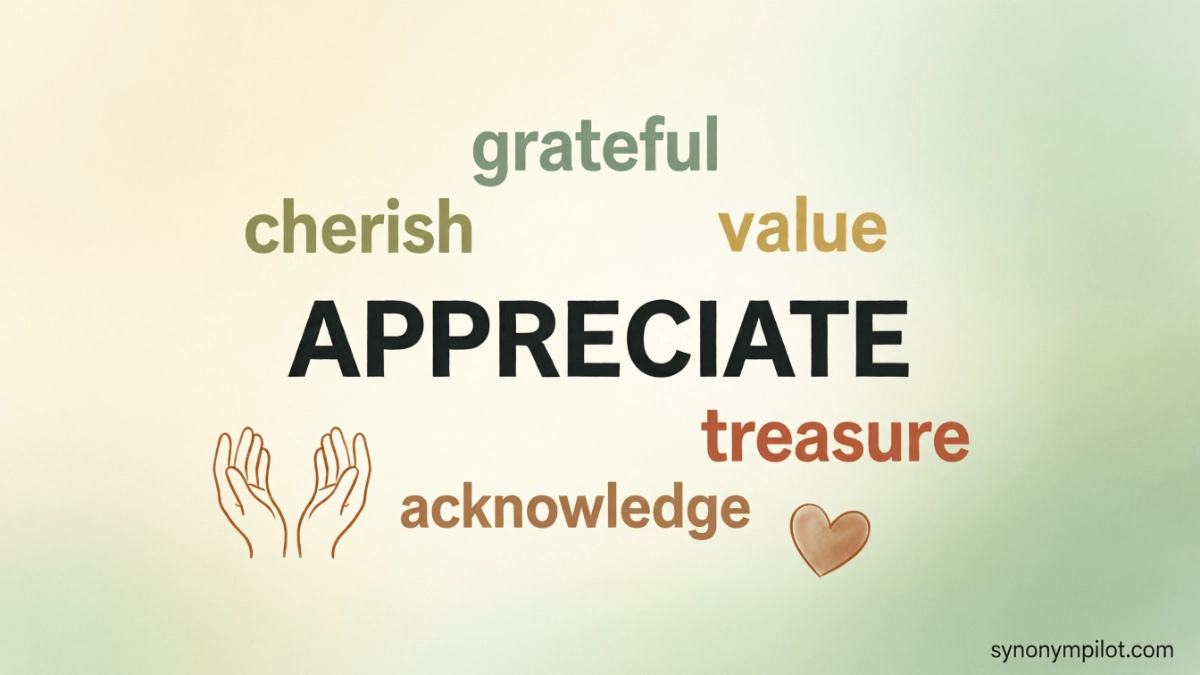
Words like “value,” “treasure,” or “recognize” can replace “appreciate” depending on whether you mean gratitude, recognition, or understanding.
A coworker stays late to help you finish a report before a deadline. The next morning, you send a message: “I really appreciate you staying late yesterday.”
It works perfectly warm, professional, and sincere. But later, writing a thank you card to a close friend who supported you through a hard year, “I appreciate you” feels slightly flat for the depth of what you want to say. Instead, you write: “I’m so grateful for everything you’ve done” or “I truly treasure your friendship.” Same core feeling, different emotional weight.
That difference is exactly what this article will help you navigate.
What Does “Appreciate” Mean?
“Appreciate” means to recognize the value, quality, or importance of something or someone, often combined with a feeling of gratitude. It can also mean to understand something fully, especially its significance or difficulty. It works in personal, professional, academic, and emotional contexts, making it one of the most versatile words in English.
Meaning, Tone, and Context
At its core, “appreciate” carries three related meanings: feeling thankful for something, recognizing the worth or quality of something, and fully understanding a situation or its significance. The tone of “appreciate” is warm, polite, and works across almost every register of English.
“Appreciate” sounds natural in professional emails (“I appreciate your quick response”), personal conversations (“I really appreciate your support”), academic writing (“students often fail to appreciate the complexity of the issue”), and formal contexts (“the committee appreciates the importance of this decision”).
Because “appreciate” covers gratitude, recognition, and understanding all at once, it sometimes feels general. Saying “I appreciate this” doesn’t always make clear whether you mean “thank you,” “I recognize how good this is,” or “I understand why this matters.” A more specific synonym often clarifies exactly which meaning you intend.
When and How to Use “Appreciate”
Use “appreciate” when you want a warm, polite, and universally understood way to express gratitude, recognition, or understanding especially in professional and personal communication.
Here are natural examples across different situations:
- “I appreciate you taking the time to explain this.” (professional, polite)
- “She has always appreciated good music.” (personal, descriptive)
- “Many people don’t appreciate how much work goes into this.” (understanding/recognition)
- “We truly appreciate your continued support.” (formal, professional)
When you want to express stronger gratitude, deeper emotional connection, or specific recognition of quality, a synonym such as “treasure,” “value,” or “be grateful for” often communicates your meaning more precisely.
Another Word for Appreciate
If you need one quick, reliable alternative depending on context:
- For expressing thanks → be grateful for or be thankful for
- For recognizing quality or worth → value or treasure
- For understanding something deeply → recognize or acknowledge
- For formal writing → acknowledge or value
- For casual conversation → be thankful for or really like
There is no single “best” replacement for “appreciate” the right word depends on whether you mean gratitude, recognition, or understanding.
When Not to Use This Word
Avoid “appreciate” when you simply mean “like” or “enjoy” without any sense of recognition or gratitude. “I appreciate ice cream” sounds odd “I love ice cream” or “I really enjoy ice cream” fits much better for simple preferences.
Avoid “appreciate” in very casual conversation when “thanks” or “thank you” would feel more natural. “I appreciate you driving me home” is correct but can sound slightly formal among close friends. “Thanks so much for driving me home” often feels warmer in casual settings.
Avoid using “appreciate” when you mean “increase in value,” unless the financial meaning is intended. “Appreciate” can describe an asset increasing in worth over time “the property appreciated significantly” but this meaning only applies to financial or economic contexts, not personal feelings.
Words Commonly Confused With Appreciate
Appreciate vs. Acknowledge:
“Acknowledge” means to recognize that something exists or is true, often without necessarily feeling grateful. “Appreciate” includes a sense of value or gratitude. “I acknowledge your effort” simply recognizes the effort happened. “I appreciate your effort” recognizes it and feels grateful for it.
Appreciate vs. Recognize:
“Recognize” means to identify or acknowledge something, often focusing on awareness rather than emotional response. “Appreciate” adds a layer of valuing or being thankful. “I recognize the challenges you faced” focuses on understanding. “I appreciate the challenges you overcame” adds admiration and gratitude.
Appreciate vs. Value:
“Value” focuses specifically on recognizing the worth or importance of something, often without the gratitude component. “I value your opinion” means your opinion matters to me. “I appreciate your opinion” can mean both that it matters and that I’m grateful you shared it.
Appreciate vs. Understand:
“Understand” focuses purely on comprehension grasping how or why something works or happened. “Appreciate” can mean understanding plus recognizing significance or value. “I understand the risks” means you know what they are. “I appreciate the risks” suggests you also recognize how serious or significant they are.
Best Synonym by Context (Appreciate)
| Context | Best Synonym | Why It Fits |
|---|---|---|
| Thanking someone | Be grateful for / Be thankful for | Direct expression of gratitude |
| Recognizing quality | Value / Treasure / Admire | Focuses on worth and significance |
| Understanding significance | Recognize / Acknowledge / Grasp | Focuses on awareness and insight |
| Formal / Professional writing | Acknowledge / Value / Recognize | Sounds polished and respectful |
| Personal relationships | Treasure / Cherish / Be thankful for | Adds emotional warmth |
| Academic writing | Recognize / Acknowledge / Grasp | Sounds analytical and precise |
| Financial context | Increase in value / Gain worth | Specific to assets and investment growth |
Which Synonym Should You Choose?
Ask yourself these quick questions before picking a replacement for “appreciate”:
1. Are you expressing gratitude or recognition? “Be grateful for” and “be thankful for” express thanks. “Value” and “recognize” express recognition of worth or importance, without necessarily implying thanks.
2. How emotionally close is the relationship? “Treasure” and “cherish” suit close personal relationships. “Acknowledge” and “value” suit professional or more formal relationships.
3. Are you talking about understanding or feeling? “Grasp” and “recognize” focus on understanding. “Be grateful for” and “treasure” focus on emotional response.
4. Is this about a person, an object, or a situation? “Cherish” and “treasure” often apply to relationships or meaningful items. “Value” and “recognize” can apply more broadly to ideas, efforts, or contributions.
Real Life Examples of “Appreciate” in Sentences
School:
“Students often don’t appreciate how much effort teachers put into grading essays.”
“She appreciated the extra time her teacher spent explaining the assignment.”
Workplace:
“I appreciate your patience while we resolve this issue.”
“The manager appreciated the team’s hard work during the busy season.”
Writing:
“The author hopes readers will appreciate the deeper meaning behind the story.”
“Critics appreciated the film’s subtle approach to a difficult subject.”
Conversation:
“Thanks so much, I really appreciate it.”
“I appreciate you being honest with me, even though it was hard to hear.”
50 Synonyms for Appreciate
| Synonym | Simple Meaning | Example Sentence |
|---|---|---|
| Value | Consider something important or worthwhile | I really value your honesty in this situation. |
| Treasure | Hold something as deeply precious | She treasures the letters from her grandmother. |
| Cherish | Care for something emotionally | He cherishes his childhood memories. |
| Be grateful for | Feel thankful for something | I am grateful for your support this year. |
| Be thankful for | Express thanks internally or externally | We are thankful for everything you’ve done. |
| Acknowledge | Recognize something exists or is true | She acknowledged the team’s contribution. |
| Recognize | Accept importance or existence | The award recognizes outstanding achievement. |
| Admire | Respect and regard highly | He admires her dedication to work. |
| Esteem | Hold someone in high respect | The professor was held in high esteem. |
| Respect | Have positive regard | I respect your effort in this project. |
| Honor | Show public respect or recognition | The ceremony honored retired staff. |
| Prize | Value something highly | She prizes her independence. |
| Hold dear | Deeply care about something | He holds his friendships dear. |
| Be moved by | Emotionally affected | I was moved by their kindness. |
| Be touched by | Feel emotional gratitude | She was touched by the surprise. |
| Be grateful to | Thank a specific person | I am grateful to my mentor. |
| Owe thanks to | Feel formal gratitude | We owe thanks to volunteers. |
| Be indebted to | Deep gratitude for major help | She felt indebted to the doctors. |
| Recognize the value of | Understand importance | He learned to recognize the value of patience. |
| Be aware of | Understand something exists | She is aware of the challenges. |
| Be conscious of | Be mindful of something | He is conscious of his impact. |
| Understand | Comprehend meaning or value | I understand your effort. |
| Grasp | Fully understand after effort | She grasped the importance quickly. |
| Comprehend | Understand deeply | Few comprehend the full scale. |
| Acknowledge effort | Recognize hard work | The award acknowledged their effort. |
| Validate | Confirm value or feelings | Her concerns were validated. |
| Be sensitive to | Consider others carefully | He is sensitive to feedback. |
| Like | Feel positive about something | I like your explanation. |
| Enjoy | Take pleasure in | She enjoys learning new skills. |
| Savor | Fully enjoy something | He savored the moment. |
| Relish | Enjoy greatly | She relishes challenges. |
| Be impressed by | Admire quality | I was impressed by her work. |
| Be appreciative of | Feel thankful (formal) | We are appreciative of your help. |
| Welcome | Accept positively | The team welcomed support. |
| Be obliged | Feel formal gratitude | I am obliged for your help. |
| Show gratitude for | Express thanks | She showed gratitude for support. |
| Express thanks for | Say thank you directly | He expressed thanks for help. |
| Count your blessings | Feel grateful for good things | She started counting her blessings. |
| Hold in high regard | Respect greatly | He is held in high regard. |
| Pay tribute to | Publicly honor | The event paid tribute to workers. |
| Be receptive to | Be open to ideas | The team was receptive to feedback. |
| Embrace | Accept positively | She embraced the opportunity. |
| Take to heart | Consider seriously | He took feedback to heart. |
| Appreciate fully | Understand completely | It’s hard to appreciate fully. |
| Be moved | Feel strong emotion | I was moved by the story. |
| Hold value in | Consider important | She holds value in honesty. |
| Be conscious of importance | Recognize significance | He is conscious of teamwork. |
| Increase in value | Become more valuable | The property increased in value. |
| Gain worth | Become more valuable | The artwork gained worth. |
Synonym Groups & Usage Differences
Formal
Acknowledge, esteem, be appreciative of, be indebted to, recognize the value of, owe thanks to suit professional emails, formal letters, and academic writing. These words sound respectful and measured.
Informal
Thanks for, like, be thankful for, be much obliged, count your blessings sound natural in everyday conversation and casual writing among friends and family.
Academic
Recognize, acknowledge, grasp, comprehend, be conscious of appear frequently in academic and analytical writing, especially when discussing significance, complexity, or understanding.
Professional
Acknowledge, value, recognize, be appreciative of, welcome sound polished and appropriate for workplace communication, performance reviews, and business writing.
Emotional / Personal
Cherish, treasure, be moved by, be touched by, hold dear, savor carry deep emotional warmth, especially suited to relationships and meaningful experiences.
Strongest vs. Weaker
“Treasure,” “cherish,” and “be indebted to” express much deeper emotional gratitude than “appreciate.” “Acknowledge” and “be aware of” are weaker they recognize something without necessarily implying thanks or admiration.
Financial (Specialized)
“Increase in value” and “gain worth” relate specifically to the financial meaning of “appreciate” when an asset becomes more valuable over time. These do not apply to personal or emotional contexts.
Antonyms of Appreciate
| Antonym | Meaning | Example |
|---|---|---|
| Ignore | Pay no attention to something | He ignored the effort his team put into the presentation. |
| Disregard | Fail to consider or take seriously | The proposal disregarded the concerns raised by staff. |
| Underestimate | Fail to recognize the true value or importance | Many people underestimate how difficult this job really is. |
| Overlook | Fail to notice or give proper attention | Her contribution was overlooked during the awards ceremony. |
| Take for granted | Fail to value something properly due to familiarity | He took his health for granted until he got sick. |
| Dismiss | Refuse to consider as important | She dismissed the suggestion without thinking it through. |
| Devalue | Reduce or fail to recognize worth | His comments devalued the team’s hard work. |
| Resent | Feel bitterness instead of gratitude | He resented having to redo the project. |
Comparison:
Appreciate vs. Related Words
These words often overlap with “appreciate,” but each carries a distinct emphasis on gratitude, recognition, or understanding.
Appreciate vs. Acknowledge
“Acknowledge” simply recognizes that something exists or is true it doesn’t necessarily include gratitude or admiration. “Appreciate” goes further, adding a sense of value or thanks. “I acknowledge the delay” admits it happened. “I appreciate your patience with the delay” adds gratitude for how someone responded to it.
Appreciate vs. Value
“Value” focuses on recognizing the importance or worth of something, often without an emotional or grateful component. “Appreciate” can include both recognition and gratitude. “I value your feedback” means it matters to me. “I appreciate your feedback” can mean both that it matters and that I’m thankful you gave it.
Appreciate vs. Cherish
“Cherish” implies deep emotional attachment, often toward people, memories, or relationships it’s more personal and intimate than “appreciate.” “I appreciate my friends” is warm but general. “I cherish my friendships” suggests something held closely and protected emotionally.
Appreciate vs. Recognize
“Recognize” focuses on awareness identifying that something is true, important, or significant. “Appreciate” adds value or gratitude on top of that awareness. “I recognize your hard work” simply notices it happened. “I appreciate your hard work” notices it and feels grateful for it.
Appreciate vs. Understand
“Understand” is about comprehension knowing how or why something is the way it is. “Appreciate” can include understanding, but adds a layer of recognizing significance or value. “I understand why this matters” shows comprehension. “I appreciate why this matters” suggests deeper recognition of its importance, often with emotional weight.
Common Phrases and Expressions
“I can’t thank you enough” an emphatic way to express deep gratitude.
Example: “You helped us through such a difficult time I can’t thank you enough.”
“Much appreciated” a short, polite way to express thanks, often used in messages or emails.
Example: “Thanks for sending that over so quickly much appreciated.”
“Take something to heart” to consider something seriously and value it deeply.
Example: “She took her mentor’s advice to heart and applied it throughout her career.”
“Count your blessings” to recognize and feel grateful for the good things in your life.
Example: “After the accident, he started counting his blessings every single day.”
“It means a lot” used to express that something has significant emotional or personal value.
Example: “Your support during this time means a lot to our whole family.”
“Words can’t express how grateful I am” used to convey gratitude so strong it feels difficult to put into words.
Example: “Words can’t express how grateful I am for everything you’ve done for us.”
Common Mistakes to Avoid
Using “appreciate” for simple likes or preferences:
“I appreciate pizza” sounds unnatural. “I love pizza” or “I really enjoy pizza” fits casual preferences much better. “Appreciate” usually implies some level of recognition or gratitude, not just enjoyment.
Confusing “appreciate” with “acknowledge” in professional writing:
“I acknowledge your email” simply confirms receipt. “I appreciate your email” suggests gratitude for its content. Using these interchangeably can change the tone of a professional message sometimes unintentionally sounding either too cold or too warm.
Overusing “appreciate” in thank you messages:
Repeating “I appreciate” throughout a message can feel repetitive. Mixing in “grateful,” “thankful,” “means a lot,” and “treasure” adds warmth and variety, especially in personal messages.
Using “appreciate” instead of “increase in value” in financial writing:
“The house appreciates” is correct in financial English, meaning its value increases. However, using “appreciate” without financial context “my house appreciates me” sounds confusing and incorrect; it should be “my house has appreciated in value.”
Forgetting that “appreciate” can mean “understand”:
“I appreciate the difficulty of this situation” doesn’t always mean gratitude it can mean “I understand how difficult this is.” Readers sometimes miss this meaning, expecting only a gratitude related interpretation.
FAQs
What is a more formal word for “appreciate” in a professional email?
A: “Acknowledge,” “value,” and “recognize” all sound formal and professional. “We value your continued partnership” or “we acknowledge the effort your team has put into this project” both work well in business communication.
What is the difference between “appreciate” and “grateful”?
A: “Appreciate” is a verb “I appreciate your help.” “Grateful” is an adjective “I am grateful for your help.” Both express thanks, but “grateful” often feels slightly more personal and emotional, while “appreciate” can also describe recognition of value, not just gratitude.
Can “appreciate” mean something other than “thank you”?
A: Yes. “Appreciate” can also mean to understand the importance or difficulty of something “I appreciate how hard this must be for you” or, in financial contexts, to increase in value “the currency appreciated against the dollar.”
What is a stronger word than “appreciate” for someone very important to you?
A: “Treasure” and “cherish” both express much deeper emotional connection than “appreciate,” especially for relationships, memories, or things that hold personal meaning.
Is “much appreciated” the same as “thank you”?
A: They are very similar and often interchangeable. “Much appreciated” tends to sound slightly more casual and is commonly used in messages, emails, or quick replies, while “thank you” works in nearly every context, from casual to formal.
Conclusion
“Appreciate” is a warm, flexible word that can express thanks, recognition, or understanding sometimes all three at once. Once you start noticing which meaning you actually intend, choosing a more specific word like “treasure,” “acknowledge,” or “recognize” becomes much easier, and your communication becomes clearer and more genuine.
This week, pay attention to the moments when you say or write “appreciate.” Ask yourself: am I expressing thanks, recognizing value, or showing understanding? Then try a more specific synonym from this article depending on the relationship and context. With a little practice, these words will start to feel natural, helping your English sound warmer, more precise, and more sincere.

Hi, I’m George Philip—an English language enthusiast who enjoys uncovering the nuances of words. I write about synonyms, vocabulary, and everyday language tips so readers can improve their communication and express themselves effectively. Learning new words should be fun, practical, and inspiring! synonympilot.com